
What can save this country?

In the wake of China’s recent bullet train disaster, I came across this poll on 开心网 (kaixin001.com):
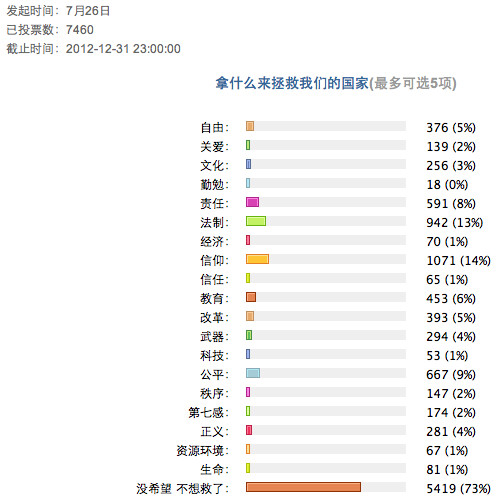
Transcription:
拿什么来拯救我们的国家? (最多可选5项)
- 自由
- 关爱
- 文化
- 勤勉
- 责任
- 法制
- 经济
- 信仰
- 信任
- 教育
- 改革
- 武器
- 科技
- 公平
- 秩序
- 第七感
- 正义
- 资源环境
- 生命
- 没希望 不想救了
Translation:
What can save our country? (choose no more than 5)
- freedom
- love
- culture
- diligence
- responsibility
- law
- economics
- faith
- education
- reform
- weapons
- technology
- fairness
- order
- the 7th sense
- justice
- natural resources
- life
- there’s no hope; don’t want to save it
In case you missed it in the original image, 73% of respondents (over 5000 in total), most of whom are young people, chose the final answer.
It’s not an easy time to be Chinese.
That’s a bit odd lumping “there’s no hope” and “don’t want to save it” together. Aren’t they independent?
It’s kinda like the “no answer” answer? —- either/or.
I’m a little confused. The percentages don’t seem right; they add up to 155%. Did they let respondents choose more than one option? Even if they did, 没希望 不想救了 seems antithetical to the other responses, so why would someone choose it and one of the other options? Or am I just missing something here?
Respondents can choose up to 5.
You’re right that choosing the last one and others doesn’t make a lot of sense; it looks like most people probably only chose the last one.
Although some people choose the other four choices, they still choose the last one, because they don’t think that those way could really work.
Even the panacea can not cure the wound in our heart.
So thsy made four other choices and that one? Seems like chinese people have a sense of humor but can’t agree how to save their country.
Maybe all of China was having a Bad China Day that day.
Someone thinks this story is fantastic…
This story was submitted to Hao Hao Report – a collection of China’s best stories and blog posts. If you like this story, be sure to go vote for it….
Interesting (if not surprising) how different environmnents can effect how such questions are answered. I bet that if you posed that question as an essay topic at an important school exam in China, answers like culture, diligence, technology, science and education would be really high up.
Not sure which would be closer to the truth…it seems quite likely that many people read the question and said to themselves: 管它呢
Yeah, I totally agree… it was just an internet poll on a social network website. It’s about as accurate a tool for truly understanding “the mood of a nation” (if there is such a thing) as asking a taxi driver about politics. (Well, maybe slightly better than that…)
Maybe I’ve been away too long but I was surprised to see they’ve made it up to 7 senses. People always used to max out at 第六感。 That, by the way, was the ability to foresee how long you could hawk knockoffs on Huaihai Road before the heat showed up.
[…] on Sinosplice, there’s a report about a poll on some Chinese website which asked the question What can save this country? The most popular answer by quite some way was “There’s no hope; don’t want to save it”. […]
I ask a lot of taxi drivers, and my impression is that they are better informed and more perceptive than the average netizen. They get around and meet a lot of people who are better off than them. Here in Shenzhen, they were recently warned not to talk to foreigners about politics as part of the preparation for the University Games!
What nobody else has mentioned is that the two most popular positive responses were the legal system and holding a belief, which is cause for hope.