
30
Jun 2004
You, Too, Could Have My Shanghai Job!
My company has decided that there’s too much work here for me to handle on my own, so they’ve asked me to find a second. Another person that can do my job. Only problem is, since I am quite busy, I don’t have a lot of time to look for someone. I just got back from Dezhou. Tomorrow I go to Fuzhou for 3 days. When I get back the next day I’ll go to Wuxi for 5 days. Then I’ll be in Shanghai for a week, after which it’s off to Tianjin for 10 days. You get the idea. School’s out now, so it’s the busy travel season for this job.
So let me tell you a little about the job. The pay is not bad (about 12,000rmb), but it doesn’t come with benefits, so it’s not exactly the most wonderful package in the world. (On the other hand, you won’t be hurting for money on that salary, even in Shanghai.) What is good about the job is that you can use Chinese (and, indeed, must use Chinese) on a daily basis. Also, the company pays for you to travel all over China. Yes, you have to work, but often your host will pay for you to do a little sightseeing, and even if they don’t, you could take a vacation day or two in that location before returning to Shanghai.
So you have to live in Shanghai. You have to deal with me on an (almost) daily basis. You have to be able to speak Chinese. You have to like to travel. And you have to be a native speaker of English, of the North American variety. If this sounds like you, please head over to Sinosplice Jobs, take a look at the information there, and then give me an email.
(For other entries I’ve written about my job, check out the “Work” category in the archives.)
28
Jun 2004德州电话
前不久我出差到山东德州去了。因为我是此行同事中唯一的男士,所以我一个人住了一个房间。星期五晚上11点多的时候有电话:
[我:] 喂? [她:] 您好,打扰一下。您需要小姐为您服务吗? [我:] 不需要。 [她:] 打扰了。
我听说过中国宾馆有这样的服务,但这是我第一次亲自接这样的电话。
星期六晚上10点多又来了这个电话。对话也是一模一样的。令我惊讶的是星期六晚上11点多她又打电话给我了!难道她以为过了一个小时我会寂寞起来而改变主意吗?
28
Jun 2004Impressions of Dezhou
This past weekend I went on a business trip to Dezhou, a city in northern Shandong province. It’s funny — before heading off to Dezhou, any person I told I was heading to Dezhou had one of three reactions:
- Had never heard of it. (Not surprising, really.)
- “Texas??” (The American state of Texas is Dekesasi-zhou in Chinese, and often abbreviated to De-zhou.)
- “Paji!” (That’s the name of Dezhou’s one claim to (relative) fame: a chicken dish called paji.)
Unfortunately, right before leaving for Dezhou I came down with a terrible cold. The fact that it’s my second time being quite sick in Shanghai in only six months of living here alarms me somewhat. I like to think I’m a pretty healthy individual, and these new statistics aren’t jiving with that. (Why could this be? My imagination takes the idea and goes with it. Maybe I’m an example of a rejected transplant. You know how sometimes a transplanted heart doesn’t take in a new body? Well maybe I’m not taking in a new city. Or maybe the city views this foreign body as a threat and is trying to knock me off with its defenses. The Chinese, however, invariably offer the same explanation: “bu xiguan.” I’m not used to life here in Shanghai. Well, there might be something to that, but really, Shanghai has got to be the easiest Chinese city to get used to. Plus that’s a pretty boring explanation.)
And so it was that Thursday I found myself on a 14-hour train ride to Dezhou, a city in northern Shandong province with no convenient airport. We left at 10am, which made for a looong day on the train. Fortunately I had my cold medicine, a big box of tissues, and my sleeper bunk. I was unconscious for most of the way there.
I woke up around 10pm and decided I had better stay up. All the lights in the train were out, save for a few floating downturned faces bathed in the ghostly illumination of a cell phone’s display screen. I climbed out of my bunk and took a seat by the window. It was storming outside. Every few seconds lightning lit up the desolate countryside for an instant. Farmland, ditches, crude buildings, lonely trees. It all seemed so foreign and yet so China. I thought about how four years of effort to “get to know China” had been successful, but only in my one little corner.
Dezhou is a wholly unremarkable city. It has no famous mountain, or lake, or park, nor is it the “ancestral home” of any famous figure that the locals could boast about to guests. All it has is paji, a chicken dish. Which is very good, by the way.
But Dezhou is a city in Shandong province, and as such, it is populated with Shandong-ren, a much-discussed group in China. I found them to be warm and generous, and although they all had that northern accent, it wasn’t nearly as strong as I expected. One might even call it pleasant. There was only one guy with whom I came into contact whose Mandarin level was sub-par. But holy crap, was he hard to understand! I never thought a speaker of a northern dialect could be as difficult to understand as a speaker of a southern dialect, but I was sorely mistaken. There was no “s/sh c/ch z/zh” pronunciaiton issue like you find in the south. I don’t even notice that anymore, anyway. This time the issue was strictly tones. The man spoke without a shred of respect for the established tones of the words that make up Mandarin Chinese. Foreigners learning Chinese do much the same thing, but they generally have the decency to speak slowly and simply, and they radiate uncertainty. This man had the gall to speak quickly and confidently in his abominable Chinese. Talking with him was certainly an experience.
I went on the business trip with three female co-workers, so I got a cheap hotel room all to myself. Friday night around 11pm the phone rang, and the following conversation ensued in Chinese:
[Me:] Hello? [Woman:] Hello, sorry to disturb you. Do you need a girl’s services? [Me:] No. [Woman:] Sorry to disturb you. click.
This kind of Chinese hotel service is well documented, but it was the first time it had been offered to me. Apparently my female co-workers got a call as well, but as soon as the caller heard a female voice, she hung up. The thing is, this exact same exchange repeated itself Saturday night at 10:15pm, and then again that same night at 11:15pm! It was the same woman calling. Did she think in the hour that had passed I had gotten lonely and changed my mind?? [Telephone conversation in Chinese]
Dezhou was not so bad. It wasn’t as polluted or as poor as I thought it might be. The people were nice, and I actually kind of liked their accents, to my surprise. But it’s still good to be home in Shanghai.
23
Jun 2004To Stay
This last time that I went home for a visit was a special one. Not because of who I saw or what I did, but because of the message I bore with me that time. It was a message that was a long time in the making, slowly gaining substance and taking on a concrete form. It was a message that had to be shared with my family, and I wanted it to be done in person.
In the very beginning, when I first decided to go to China, I told people that I planned to stay for a year or two, to get a feel for the language. In reality, I knew it would be longer than a year, and likely longer than two. I had experienced life abroad in Japan, and I liked it. I knew any proficiency in Chinese would take time, but I also had a special feeling about China, even before I had ever been there. Still, I didn’t really expect anyone to understand those things. It seemed best to keep telling everyone that I planned to stay for a year or two.
Well, year two came and went, and as I expected, I was not ready to leave China. Friends back home would ask how long I intended to remain over there. I usually gave an elusive “maybe another year.” I didn’t want to say that I had no idea when I would be ready to leave. That would make it seem like I had no direction. The truth of the matter was that the longer I stayed in China, the more direction I felt I had. But again, I found it hard to explain. “Maybe another year” was an easy answer, and most people didn’t really need to know anyway.
Still, I had conflicts. I knew that my main interest was Applied Linguistics, and the program at UCLA looked appealing. I knew I could get in and do well in that program, and I wanted a Masters from an American university. But what after? It seemed logical that after I had my degree it would be time to settle back down to life in the United States, time to “get a real job.” The only problem was that I was not ready to leave my life in China behind, and that was what going for the degree seemed to represent for me.
The summer of 2003 a friend who was also teaching English visited me from another part of China. We got to talking about our lives in China and our plans for the future. What he said shocked me. “I’m staying here. I’m going to make a life for myself in China.” Up to that point, I had never seriously considered such an option. It was a possibility I would mull over for some time.
Throughout my own confusion, I had no problem giving friends vague answers, because the truth of the matter was that my own plans were still pretty vague too. I longed to share some of my thoughts with my family, but I wanted to sort everything out for myself first. The question I found to be the hardest to bear, though, was one that I really only got when I visited home. It was always asked innocently, yet in complete earnestness, and it pinched my heart every time. It was my mother’s quiet, “John, when are you coming home?”
I think it was that question, more than anything, that put definite pressure on me to adopt a real plan in lieu of a “take things as they come” philosophy. I needed to know for myself too.
I weighed the factors. What did the USA hold for me? Family. Old friends. A miserable job market. What did China hold for me? Passion in my life. Excitement. A society that would never fully accept me. The possibility of a real, promising career in the very field I was into. And a love relationship I was not willing to leave behind.
I think it’s obvious which I chose. Yet to feel good about it, I felt that I really needed my family’s full support. I knew my sisters would support me, and that my parents would tell me they wanted me to follow my dreams, but I wanted more than that. I wanted them to understand why I was doing it, and I wanted them to support me with their hearts, because I already found it so difficult to see them a little older every time I went home. The years before they’re actually old were dwindling, and I couldn’t continue my life in China and be with them at the same time. I didn’t want there to be any resentment or disappointment on anyone’s part that I had spent those years in China.
On my recent visit home I had a talk with my family. It was really hard for me to do. And they gave me the support I hoped for. I know that they’ll miss me as I do them, but they understand what I’m doing, and they would never ask me to do anything other than that which I love.
Now I am ready to confidently proceed with my life and my career in China. I still plan to go to graduate school in Applied Linguistics, but it will be in Shanghai, in Chinese. My life here is more full of promise than ever.
And when people ask me how long I’ll be in China, I know my answer.
Indefinitely.
21
Jun 2004Field Chickens and Bleached Buns
I had lunch with some clients today. One of my co-workers, a teacher for my company, was there with me. She’s a Dongbei-ren recently arrived in Shanghai, so she’s still not used to the south in many ways.
One of the dishes we ate was called tianji, which literally translates as something like “field chicken” (“field” in the sense of “rice paddy” here). I had forgotten what this dish really is, so I was kinda glad when she asked, “what kind of bird is it?” Our hosts laughed. In China, a “field chicken” is actually a frog! I ate it, though. It’s pretty good, it just has a lot of annoying little bones. And it does taste kind of like chicken.
Another dish we had with which my Dongbei-ren co-worker was unfamiliar was suji. Literally, I guess it could be translated as “vegetarian chicken.” It’s a kind of tofu. It doesn’t really taste (or feel) much like chicken.
The clients were surprised that the south had so many dishes with which a northerner would be unfamiliar. They asked her what dishes the north had that the south doesn’t. She listed a few, but then mentioned that one should be wary of the mantou in Liaoning province. She said a good mantou should be a bit yellowish. A mantou that is too white may have had laundry detergent added to make it look whiter and thus more attractive to the consumer!
20
Jun 2004Gui Lian
We say, “make a face.” The Chinese say, “make a ¹íÁ³.” Gui lian is kinda hard to translate literally because ¹í can mean “ghost” or “demon” or a bunch of other things. Á³ means “face.” In this case there’s no trouble understanding, though. Below are some of my students’ gui lian. (click on the image for a gallery of cute kids)

There, now some people might momentarily stop nagging for more pictures (you know who you are). I made the “Chinese Kindergarteners” photo album with the very cool Simple Viewer. It uses Flash.

19
Jun 2004China has had its Share of Hard Times
Normally I’d link instead of copying a whole post, but this comes from a blocked site, and we all know how annoying that is. So, with my apologies to Harry, I’ll rape the entire post from Chase me ladies, I’m in the cavalry  . Not sure where he got the info.
The worst flood in history:
China, 1931; 3.7 million dead.The second worst flood in history:
China, 1887; 900,000 dead.The worst earthquake of the 20th century:
China, 1976; 242,000 dead.The second worst earthquake of the 20th century:
China, 1927; 200,000 dead.The worst earthquake in history:
China, 1556; 830,000 dead (est).The worst famine in history:
China, 1959-61; 20 million dead.The second worst famine in history:
China, 1876-79; 10 million dead.The worst civil war in history (second worst war of any kind):
China, 1850-64; The Taiping Rebellion; 20-30 million dead.China also lost more people in World War 2 (10.45 million) than Germany (5.5 million) and Japan (1.9 million) combined.
I’m not crazy about either history or politics, but that doesn’t mean I think it’s OK to completely ignore them. I’m not going to give any further commentary; I think the figures say enough.
19
Jun 2004我最喜欢的书
我最喜欢的书是日本作家村上春树的《世界末日与冷酷仙境》。我知道很多中国人都看过《挪威的森林》但好像没人听说过《世界末日与冷酷仙境》。你听说过吗?在中国大陆有的卖吗?
18
Jun 2004New Host
Sinosplice is now on a new server. I took long-time commenter Pketh‘s suggestion and went with Surpass Hosting. Thanks Pketh, their hosting package is really incredible. I hope the speed will be comparable to my last host’s, but even if it’s a little slower, I’m still getting way more space and other features for less money.
It seems like the DNS entries have just about finished switching over, but I think my e-mails are being delayed. If you e-mailed me in the past 48 hours and I haven’t responded, you might want to wait another 24 hours and resend it. I’ll try to get all that straightened out ASAP.
Due to the way DNS entries propagate, yesterday I could view my site on the new server all day at work, but when I got home I was still viewing it on the old server! I knew because of the comments. The good part about that is that I was able to easily save the new comments for my last entry that were posted in the DNS switchover period. I’ll put them back up when I get home.
A big thanks also to Wilson for doing the actual data transfer for me from San Francisco. I couldn’t do it myself because my FTP connection with Webmasters was completely unusable.
So here’s hoping that everything returns to smooth normality soon…
15
Jun 2004陈宝莲与鬼电梯
jennifer 说:
你有在弄你的chinese blog 吗?
潘吉 说:
弄什么?
jennifer 说:
就是说继续写点什么
潘吉 说:
哦,今天没有
潘吉 说:
我想写,只是最近没有时间
jennifer 说:
现在不是我一个人打不开,是很多人都打不开
jennifer 说:
你知道陈宝莲吗?
潘吉 说:
陈宝莲?不知道
潘吉 说:
我的学生?
潘吉 说:
我可能知道英文名字
jennifer 说:
不是你的学生拉~是一个HK艳星
jennifer 说:
就在你住的这个小区跳楼自杀的
潘吉 说:
哦!我还以为你还在讲我的网站的事!
潘吉 说:
你怎么知道她??
jennifer 说:
呵呵~你的网站的事就是我真的是打不开
jennifer 说:
而且已经很久了
jennifer 说:
因为去年我有个朋友也是住在那里,他和我说的
潘吉 说:
很久了??
潘吉 说:
那么你知道她从1号楼还是2号楼跳了吗?
jennifer 说:
嗯~有点久了
jennifer 说:
是1号楼
jennifer 说:
你是几号?
潘吉 说:
确定吗???
jennifer 说:
确定,不要告诉我你也是1号楼哦
潘吉 说:
我2号楼。呵呵
潘吉 说:
她从几楼跳的?
jennifer 说:
24
潘吉 说:
哦
潘吉 说:
还好
潘吉 说:
因为2号楼有一个很奇怪的电梯,我们叫它“鬼电梯”。后来知道了原来有人在南阳小区自杀过!!!
jennifer 说:
你小心啊~呵呵~
jennifer 说:
电梯怎么奇怪?
潘吉 说:
如果两个电梯都在1楼,然后坐非鬼电梯,到了12楼出来经常发现鬼电梯跟着非鬼电梯上来了。在12楼门开,里面没人。
潘吉 说:
而且晚上如果想出去,我一出门经常发现鬼电梯等着,一看到它门都开!里面也没人。
jennifer 说:
阿??不用按按钮,它门就开吗?
潘吉 说:
对
潘吉 说:
好像它在等我
jennifer 说:
你不要说的这么恐怖
jennifer 说:
其他人看见他也一样吗?
潘吉 说:
鬼电梯很破,它给我的感觉就是很可怜,很希望人家坐它,而不是新点的电梯。
jennifer 说:
那你有坐过吗?
潘吉 说:
我的女朋友也看到过。
潘吉 说:
经常坐
潘吉 说:
还有!有一次虽然我按了12楼它在12楼不停,一直往上去。到了25楼它就停,门都不开。我只能用电梯里面的电话叫师傅来救我。
潘吉 说:
但没事
潘吉 说:
所以我很怕你会说她是从2号楼25楼跳的!
潘吉 说:
(也许她的朋友住在12楼?)
jennifer 说:
呵呵~还好,我说的数字都加1就是2号楼25楼了
jennifer 说:
很有可能!!
jennifer 说:
她有个孩子,去过12楼
潘吉 说:
孩子去过12楼?你怎么知道?
jennifer 说:
哈哈~我乱说的
jennifer 说:
干吗阿~我就适当的联想一下嘛
jennifer 说:
不过是不太可能
jennifer 说:
因为她的孩子才1个多月
jennifer 说:
要不就是孩子的保姆带他出去逛逛
潘吉 说:
我要下班!
潘吉 说:
88
14
Jun 2004Dashan in Shanghai
Ever since he wrote to me, I’ve been in communication with Mark Rowswell (AKA Dashan) via e-mail. Well, this past weekend he came to Shanghai to shoot a few commercials, so we got together for a chat.
As a public figure, he really has to watch his image, and there’s a lot he doesn’t talk about publicly. It was really interesting, then, to meet Mark and hear some of his opinions. We talked about a range of topics, including English education in China, the meaning of the recent loss of the Stanley Cup to Canada (go Tampa Bay! — I guess), what it was like to be a student in Beijing in 1989, and running a website (he manages his site and all its content all on his own).
I spoke with him on the set of his commercial in between shots. I have to say that observing the shooting of a commercial is both interesting and very boring. Once is enough. I’d hate to have to do it to pay the bills.
After the commercial he treated my girlfriend and me to dinner. I never would have guessed where he wanted to eat — Malone’s! It’s quite the expat hangout, and although it’s not the cheapest, the burgers are really good.
I was also curious if he was going to be recognized as we walked the streets of Shanghai. He wasn’t, for the most part, although I did hear some of the staff whispering as we went into Malone’s, “isn’t that Dashan??”
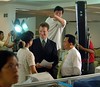


Anyway, it was good to meet someone so high profile and yet so poorly understood as Mark. We also discussed some small projects we may be collaborating on in the future. Stay tuned.
12
Jun 2004Sinosplice is in Trouble
Readers in China may have noticed that recently Sinosplice has suffered a major slowdown. The phenomenon is not limited only to this site, however; other friends in China have supported my observation that there seems to be an overall slowdown in traffic from international sites. Unipeak, a free proxy service that has recently become popular, has been shut down shortly after adding a Chinese version (which was stupid).
The problem is that Sinosplice has gotten so bad for me that server requests frequently time out. Using webmail and the hosting service’s control panel has become frustrating. My FTP connection is now so tenuous as to be rendered useless.
My hosting service, Webmasters, has been a pretty great host (especially when compared with iPowerWeb, “host of the damned”), but there’s nothing they can do about a problem that only exists on the China side. Dammit.
So my options are: (1) wait it out, and do very little with my site in the meantime, or (2) find a new host. I don’t want to go through the hassle of finding a new host, but I certainly have no reason to believe that Webmasters’ servers are going to get any faster in China. Also, probably now more than ever before, I have lots of cool (non-blog) features that I want to implement, which makes the timing particularly maddening. So I’m looking into option #2. This option is actually feasible because Webmasters will refund any unused portion of the year’s payment. Sweet.
Dreamhost, a host I discovered through the truly awesome, musically ingenious Songs to Wear Pants To (go there now!), has a really good package. I have yet to determine how good the speed in China is.
So I think Sinosplice has some rough waters ahead, and possibly even more downtime. Any hosting recommendations or other solutions are greatly appreciated.
10
Jun 2004The World Star Gazette
Ever heard of The World Star Gazette? Sounds kinda like a tabloid. I was looking through my referrals and found one from the World Star Gazette. So I checked it out to see what it was. At first I thought I was looking at a cheap imitation of The Onion. Then I got to my own entry and I finally understood what it’s about.
The World Star Gazette is riding on the tide of blog syndication popularity. Much like the Living in China aggregator, it uses the feeds of various blogs to collect links and excerpts which it then places together on one page. Besides the front page, it also has different sections such as “politics,” “religion,” and “travel.” The creative part is that the World Star Gazette makes up its own humorous headlines for the blog entries, and usually does a pretty good job (although some people may not be pleased with the modifications). It currently has two of my entries listed as After Four Years in China, America’s Diversity, Fatties and Free Refills Are Shockers and China’s Urkel Actually Canadian (Haha, they’re calling Dashan China’s Urkel!).
I’m finding the new site a refreshing way of checking out some new blogs outside of my usual reading circle.
09
Jun 2004Qipao Parade

I’m still getting over jetlag and don’t feel like writing much. Instead, I’ll share this little qipao gallery of some of China’s famous female stars. (Note that there are 4 pages in all; the links to the other pages are at the bottom of the pages.) Notably absent is Gong Li. Also, page one is not the best of the lot.

I don’t explore these Chinese portals very much, but I was kinda surprised by some of the content put online when the media are “controlled” and the government tries to always keep a wholesome image. Some of the ones I’m talking about are the “leisure” section’s Christy Chung feature (quite bizarre, and revealing), the creative bust cover-up feature, and the Maxim gallery (gee, I wonder if Maxim’s getting those royalties…).
What’s the strategy here? Give people just enough of what they’re looking for on Chinese sites so they don’t go elsewhere and discover the immense wealth of information (AKA “porn”) out there on non-Chinese sites?
Seems to be.
Update: Micah in the comments has pointed out a similar gallery which has better, higher res images. Very nice.
06
Jun 2004Trip Labels
Today my friend Dan became the happy husband of a beautiful girl named Mya. It was a nice ceremony full of great people. I was a groomsman. It was the first time since high school prom that I wore a tux. Someone remarked to me that I probably wouldn’t be wearing one again until *I* get married. That may very well be true.
I’ve noticed that every time I come home, there’s often a different atmosphere that blankets the nation, and it gives my visit a theme. This time I came home for these specific dates because I wanted to attend Dan’s wedding, but there were larger forces at work coloring my stay. Pop culture and marketing forces. This visit was the Low Carb visit.
This is not to say, of course, that my eating habits were at all low carb. Far from it. I value each and every meal at home too much to be more than just remotely concerned about petty “health” issues. Besides, I was looking to gain a few pounds. So no “low carb Doritos” for me (although I did try the new guacomole flavor — yum!).
So the themes went something like this:
- Summer 2001: The first visit back. The country wasn’t significantly different from what I remembered yet, and the focus was “so how’s china?”* and “how long do you think you’re going to stay?”**
- Summer 2002: The Post-9/11 visit. Quite a bit of time had passed since the actual terrorist act that rocked the nation, but its effects were still quite evident to someone who had not been in the U.S. when the attacks occurred and was not there for the subsequent aftermath.
- Winter 2002: The Surprise Christmas Visit. The country was basically the same as during the Post-9/11 visit, so I concentrated on the surprise element to spend Christmas with my family.
- Spring/Summer 2004: The Low Carb Visit.
So now that the latest visit is over, I return to Shanghai. I think I started to miss China a little at the 12-day mark. Or maybe I just miss my “mission” and life there. In any case, I’m headed back and will write more frequently once in Shanghai.
* Probably the single most frequent and annoying question I get. I believe that it is usually asked out of genuine interest, but the question is just too big!
** This is a question that won’t go away, but I finally have more definite answers. I’ll be writing more about this very soon.

P.S. My site was down for about half of yesterday because the hard drive on which my site was hosted crashed. All data has been recovered, and now I expect no more down time ever again. Ever!
01
Jun 2004America Revisited
This past weekend I helped my sister Grace move into her new apartment in Atlanta. Atlanta seems like a cool city, and the area she’s living in really impressed me as being so green. Trees and grass galore. The really bad part about life in Atlanta seems to be the horrible traffic.
I hear from different people about “reverse culture shock,” a phenomenon experienced after one acclimates to a foreign culture and then returns to one’s home country. Since I’m not home to stay, but only visiting, I don’t think reverse culture shock applies in this case. But after spending almost four years in China, there are certainly aspects to life in the US of A that stand out.
There are two big ones that slam me in the face as soon as I arrive at the airport, and they can be summed up in a word each. Diversity and Obesity.
America: strength in diversity. When I taught a college-level American Society and Culture class in Hangzhou, I used to emphasize the role of diversity in American culture. It really is pervasive. It explains much of our mindset and behavior, and I think it’s something that’s hard to understand if you live in a mostly homogeneous society such as China’s. China’s “56 ethnic groups” really pale in comparison to a society built by people from all over the world.
And yet when I return to the United States and see all the different skin colors and body types, when I hear four different languages spoken within a span of five minutes and it’s nothing unusual, it doesn’t cause me to reflect upon the various achievements of such a diverse population. It just makes me feel warm and cozy inside. Because America is like that — it’s diverse — and diversity is good.
America: land of the obese. This is a topic that’s been discussed to death, but I find it so fascinating to revisit it again and again because it’s so complex. It’s about our advertising industry, our food culture, our image as a nation, our societal subcoscious. Every time I come back to the United States, I’m confronted physically by the same old question: Why the hell are Americans so damn FAT?? There’s no simple answer.
Today in the car on the way back from Atlanta, I was listening to some comedy on tape. The comedian was talking about diet programs, and one in particular that he’d like to market. It was called the “Stop Eating, You Fat Bastard” program. I have to admit, that’s largely the way I feel about the issue after having lived in China for so long.
Besides those two staples, I’ve had some other minor observations. All the greenery in Atlanta was one of them. It was so refreshing.
I am also very unused to strangers greeting me. You know, the random guy you pass on the sidewalk that looks you in the eye, and for no reason at all just gives you a “how’s it going.” In America, strangers say hi to you for no reason at all. Crazy.
And then I was eating in a deli-style restaurant with Grace on Saturday. I was almost done with my drink when I stopped to ask her, “are there free refills?”
Looking at me like I was a bit simple, she responded with, “why wouldn’t there be?” Ah, America, Land of the Free Refill, I have missed thee…
After that meal I got chastised by Grace for leaving my tray on the table. Oops.
In a week I’ll be back in a country where restaurant staff are bewildered by customers who clear their own tables.
But I don’t quite miss it… yet.
25
May 2004Heading Home (after a year and a half)
Last time I went home was Christmas, 2002. It seems like a really long time ago because, well, it sort of was. For me. And yet at the same time I feel like I’ve got so much going on here in Shanghai that I’m not ready to go back home yet. But I am.
I’m headed home again today in a few more hours. Not sure if I’ll have much time to write during the two weeks that I’m home or what I’d write about if I did.
My good friend Dan is getting married. My family is looking forward to seeing its most inaccessible member. And lots of food awaits eating.
23
May 2004Yangmei are back!
I’m not too keen on some of Asia’s “exotic fruits,” such as durian and lychee. There is one, however, that I love. It’s called yangmei. According to both Wenlin and my big fat awesome New Age Chinese-English Dictionary, the English name is “red bayberry.” Does that help you any? Because it tell me nothing. The New Age dictionary also tells me its scientific name: Myrica rubra. Since most of us aren’t botanists, I better supply a picture.

Yangmei make great finger food.

When in groups, yangmei are not afraid of heights.
Yangmei are about the size of a grape, and somewhat resemble a raspberry on the outside. The taste is similar to a strawberry, I think. Some are sweeter, some are sourer. The fruit is pulpier than a strawberry, and there’s a pit in the middle about the size of a cherry pit. Good stuff.
Can you buy these overseas? I’m not sure. But if you’re in China, be sure to try them if you haven’t yet. It’s once again yangmei season, and it’ll only last for the summer.