
Defense and Defecation

I had to laugh when I stumbled across this the other day:
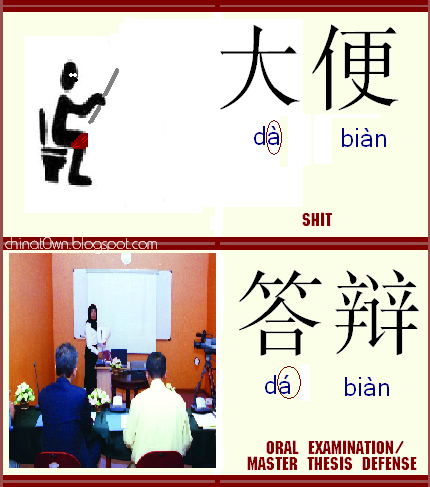
It’s an important tone difference which I learned a while ago but didn’t actually personally encounter much until this past semester as a grad student, when suddenly the word “dabian” kept popping up everywhere.
Just imagine (mis)hearing your professor tell the class: “I have to cancel class this Thursday because I have to take a dump.” The silly schoolboy in me inwardly giggled every time.
Image via chinat0wn.
shui3 jiao3 (dumplings)
shui4 jiao4 (sleeping/intercourse)
she2 tou (舌頭, tongue)
she2 tou (蛇頭, snakehead/human trafficker)
收拾 (shou1 shi, clean up)
首飾 (shou3 shi4, jewelry)
I feel like I am in primary school again.
Tian,
Nice examples, but there’s still something especially funny about the possibility of confusing academia and pooping.
Tian,
BTW, what’s up with the 繁体? Have you converted?!
Reminds me of Chinese class when the teacher told us that ‘wu’ was wife. (Don’t know the tones or the proper pronunciation now.) A student then asked “What’s ‘wu wu’ (Whoo – Whoo) then? Mistress?”
John,
i don’t how other chinese-speaking people think about it, but i don’t think the second word can be confused as the first one even if you mispronounce it. there are so many chinese words of similar or same pronounciations and native speakers usually understand a particular word from its context, so it’s not likely that a native speaker misunderstands the meaning of that word as another one of similar pronounciation.
in a recent talk show on CCTV, the eidtor-in-chief of Encyclopidia Britanica said that chinese pictographic language is the major obstacle for foreigners to learn mandarin, and some foreigners i know can only read and write PinYin, so why it’s difficult to develop a alphabetic system of chinese for daily use?
Maybe nothing to do with previously written, but us the Spanish find funny (at least in the beggining, the first 1.300 times) some very frequent Chinese expressions that sound bad in Spanish:
Bu da (not big)
Bu dong (don´t understand)
I can’t help but snicker when I hear Taiwanese people say 炸雞. Normally, the 炸 is second tone for “fry” and fouth tone for “explode”. That would mean that 炸雞 zhá jī, and 炸彈 is zhà dàn. That’s what all the dictionaries and Chinese textbooks for foreigners here say… BUT most younger Taiwanese people always pronounce 炸雞 as zhà jī. No matter how many times I hear it, I can’t help but picture an exploding chicken.
John,
Personally I feel 繁體字 are more elegant than 簡體字. It seems 簡體字 is often only used within Mainland China.
Er. Fry is “zha2”?!? Is this some wacky northern pronounciation? I (and every other Mndarin speaker I know) have always pronounced it “zha4” (actually, “za4” by the southerners).
Not to start a religious war, but I was under the impression that simplified characters are used in Singapore and by many Chinese abroad, and taught to the majority of Chinese language learners across the globe.
I have a friend (lao wai) like bingfeng’s friends, she’s asked me whether there is an application (web page or desktop) that can translate Chinese character text into just pin yin. I said I only knew about Kingsoft’s 金山词霸. Has anyone seen anything like I’m describing?
Hmm… maybe it’s some weird “older Taiwanese 外省人” thing, Richard. I’m in Taiwan. All the dictionaries and text books here say fry is zhá and most even list 炸雞 zhá jī as an example. That’s how all my teachers in 台北 talked, too. But after I moved to 龜山 (also in Taiwan), I’ve only heard zhà jī. Hmm… I just checked that red Oxford concise dictionary and it says zhá. Maybe that was the old way, and the pronunciation’s changed?
I don’t know… but either way, exploding chickens…. exploding chickens…
Agreement with Tian that 繁體字 look more elegant, and they also make you appear more intelligent (I think). As far as I knew, if you were part of the Chinese diaspora and you went to Chinese language school on the weekends, you were taught 繁體字. For higher education as an example, my university professor used 簡體字,though, so maybe it depends where you’re learning …
Times, try Adsotrans:
http://adsotrans.com/
Tian,
Aesthetic preferences aside, I figured that since you grew up in the mainland, you would stick to what you were used to. So I’m wrong in either: (1) that you grew up in the mainland, or (2) that familiarity with a character set fosters loyalty to it.
John,
I did grew up in Mainland China and was taught with Simplifed Chinese. Personally I feel some of the simplified characters have lost their true essense. I was talking to a friend last night about Chinese language. He said he was told in his Chinese history class, the reason Mainland China adopted the Simplified Chinese was to increase the literacy rate. I have also heard from conspiracy theorists that the real reason for Mainland government to push for Simplified China was to create an intentional gap between mainland and Taiwan.
Chinochano, have you ever been to 普陀山 (putuo mountain)?
speaking of mountains, does anyone know why Brokeback Mountain was translated as 断臂山 and not 断背山?
Speaking of dabian and silly schooboy snickering, I just couldn’t resist the following word association: 大便,小便,方便,方便面
Haha, good one.
Someone once asked me for a 打火机 (lighter), and I thought he wanted a 大火鸡 (turkey)!
Dan
[…] Sinosplice is another blog. This one happens to be from a grad student in Shanghai, John, who is an American from Florida. He has been living in China for over 5 years now and has some great perspective on the language and life here. He is keenly interested in the language and thus many of his posts deal with the finer points of the Chinese. I found one of his posts on the difference between shitting and a thesis defense to be rather amusing. […]
So I’m in a masters program at Beijing Normal and we’ve been told many, many times that the best way to prepare for your own pooping is to go listen to your older classmates poop:
“你们准备答辩的最好的方法是去听你们的师姐师兄们答辩。”
Gets me every time.