
Learning Curves: Chinese vs. Japanese

I’ve been asked many times: Which is harder to learn, Chinese or Japanese? Well, the latest time finally inspired me to make this graphic. I think it’s pretty self-explanatory, but some notes will follow anyway.
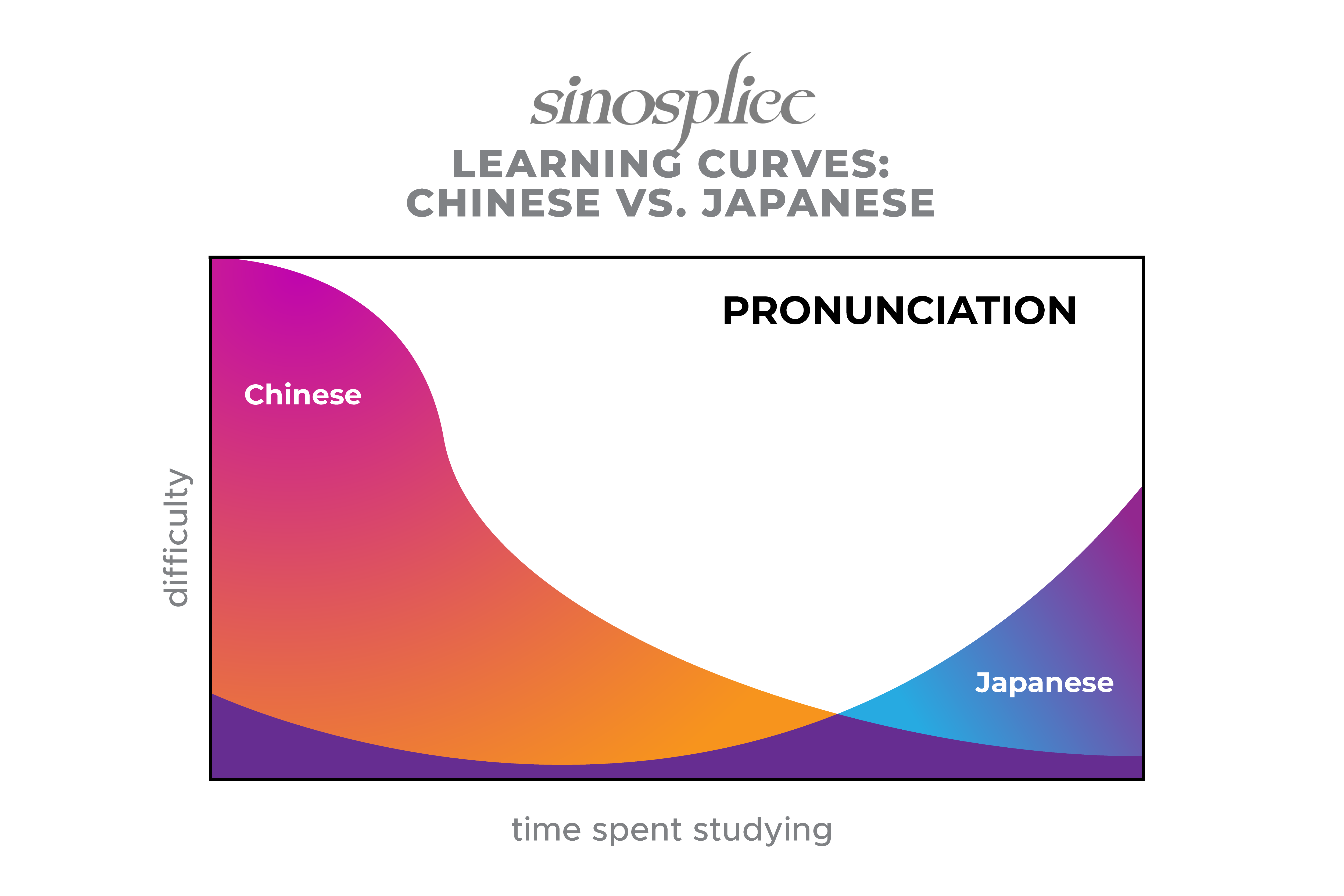
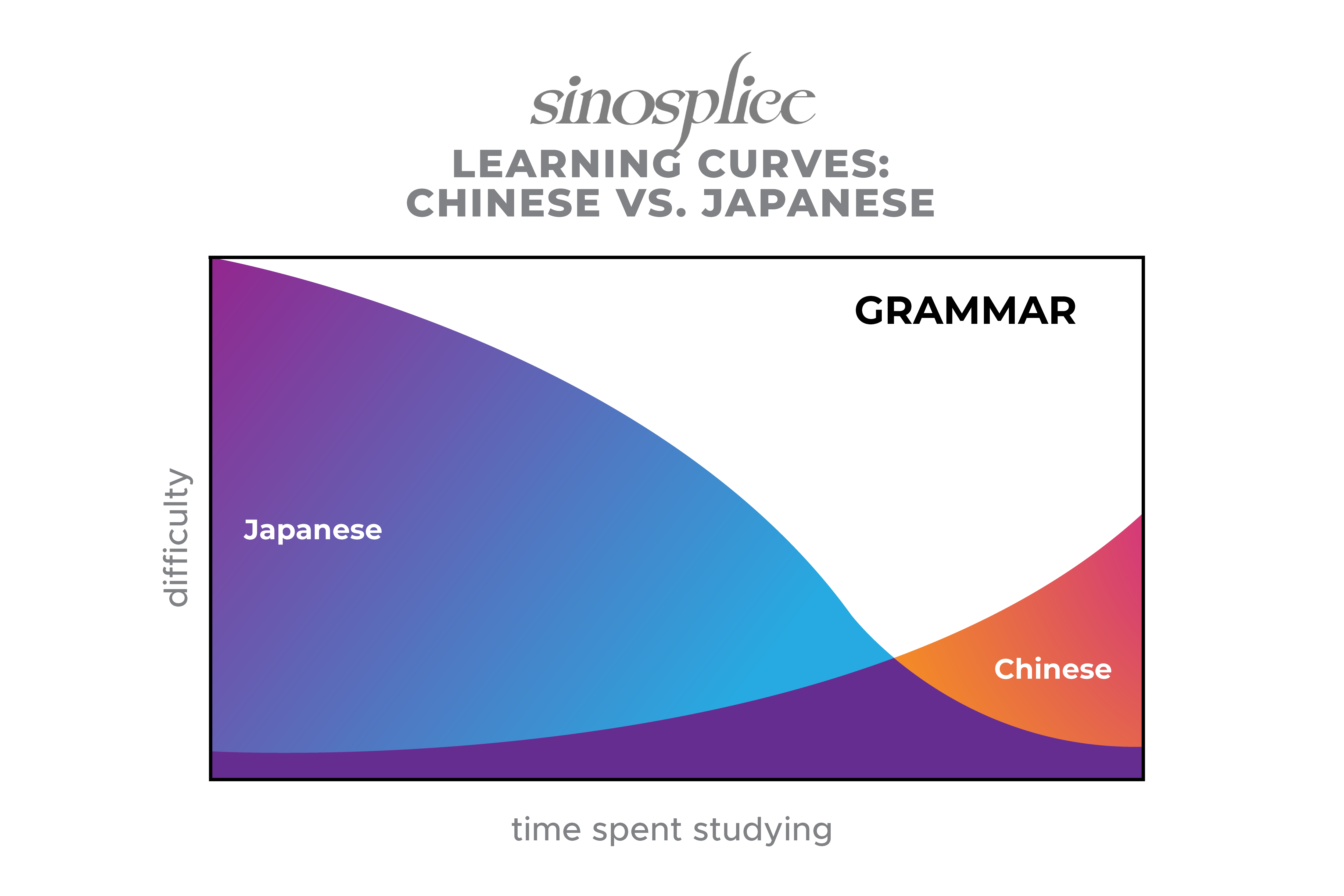
In case you couldn’t figure out from the graph, both are difficult, but in different ways. Both have insane writing systems and lots of cultural background to learn, so those basically cancel each other out. Any language requires lots of vocabulary memorization. Japanese has loads of loanwords from English, but really learning to use the loanwords like a native speaker instead of a crutch is not so easy to do, so I left that factor out as well. For me, the major points of comparison come down to just pronunciation and grammar.
Japanese pronunciation is quite easy at first. Some people have problems with the “tsu” sound, or difficulty pronouncing vowels in succession, as in “mae.” Honestly, though, Japanese pronunciation poses little challenge to the English speaker. The absolute beginner can memorize a few sentences, try to use them 20 minutes later, and be understood. The real difficulty with Japanese is in trying to sound like a native speaker. Getting pitch accent and sentence intonation to a native-like level is no easy task (and I have not done it yet!).
Chinese pronunciation, is, of course, maddeningly difficult from the get-go. It can be so hard to make yourself understood when your sentence is only three syllables long. Yes, I know. I’ve been there. If you keep at it, though, things get waaayyy easier. And in the later stages, accent isn’t as big a deal in Chinese. There are so many wildly different accents in China alone that once you get your tones under control and can string a coherent sentence together, Chinese people will often assume you’re a native speaker in telephone conversations.
Chinese grammar starts out fairly simple for English speakers. Some find it so simplistic that they say things like, “Chinese has no grammar.” This is not true, of course, and there are a few difficult points to master (like 了, which probably occupies a good chunk of the red area in the middle of the grammar graph), but overall, the grammar is not too rough. If you want true mastery of the language, however, you will also eventually have to study 古文 (ancient Chinese), and that’s quite a bit more work.
Japanese grammar starts out seeming like some bizarre alien code. However, through hard work and determination, the persistent can eventually crack it. Once you get over the grammar hump, and verb conjugations, causative-passive, は and が, and keigo are no longer a big deal, you’re in a pretty comfortable place. But it sure is rough at first.
Just to be clear, this is all based on my personal experiences as a very acquisition-conscious language learner, not on scientific research. Please feel free to add your own experiences with these two languages in the comments.
I don’t really know anything about Japanese, but I’ve always summed up the difference between studying English and Chinese like this. English is relatively simple, but gets more and more complicated the more you get into it. Chinese is a big clusterfuck at first (especially tones, and characters), but just gets simpler and more logical the deeper you get into it. I think this is why many people think Chinese is so difficult–because the hard part is all at the beginning. Once you get over the initial hump, everything starts to make a lot more sense.
I’m just starting off studying Japanese, having studied Chinese for the past few years. Your graphs are pretty much spot on, and it’s a lot easier getting a basic repetoire of Japanese sentences than it was for me to do the same in Mandarin.
Any Japanese study resources to recommend?
I reccomend Berlitz, you can get it for pretty cheap in book sotres, and its AWESOME
hi i’m learning korean but when i heard japanese’s pronounciation , i became so confused between both of them , comparing to the chinese or japanese language , actually korean langauge is the simplest . but now i think i wanna start learning japanese because i’ve more chances to go there
I can offer an observation by proxy.
A work colleague spent a three week holiday in China last year and a three week holiday in Japan this year. He spent a fairly diligent and equivalent few months on each language before each holiday, with no real expectations of continuing after the holidays.
Verdict, although he felt he had learned an equivalent amount of language in each the Chinese he learned was next to useless on the ground, but he had real fun with the Japanese (people understood what he was saying). This would seem to agree with your feelings.
I had the same feelings about Japanese grammar. At the very beginning, it was terrible. After a while, though, it helped me a lot. When hearing unfamiliar words in a conversation, I often realized immediately whether if they were verbs (う行), gerunds (ている), adjectives (な or い), or some other part of speech. That sped up the process of figuring out what those words meant. With Chinese on the other hand, new words often come in the form a random syllable or two that could mean just about anything.
John,
what struck me in your post was that mean, little 古文-inset. When will you start teaching us some 古文-basics over at CPod? Level #7?
My colleagues and I were just having this discussion and we came to a similar conclusion – that Chinese pronunciation is killer and Japanese keigo and grammar are brutal. I would add one more thing that makes Japanese really difficult – the difference in men’s and women’s language. I learned Japanese the way I learn all languages, by living in the country, listening to people and imitating what they say. But with Japanese I had to tag things in my brain like “heard a man say this, haven’t heard a woman say it yet so I can’t use it myself yet”. It was maddening.
Oh, and would you agree that it’s easier for Japanese and Chinese people to learn each other’s languages than it is for a native English speaker to learn either language?
I think John got the analysis about spot-on. Japanese grammar was really quite stunning at first, and it’s really a concept that requires time more than anything else to stick. You can try to cram all the grammar in a relatively short period of time, but truly understanding concepts at a natural level really takes, what i have come to believe, the unconsciousness to digest the elements and that all just takes time. I know this b/c several times i tried to understand grammar concept and didn’t come back to it until half a year later, but i actually grasped it much better than before.
And to answer your question,as an American of Chinese descent who has been learning Japanese by myself online, I think that knowing Chinese really does help in learning Japanese to some extent. Even the grammar concepts are actually more similar than some native English speakers claim. Early on in my studies, I realized I could try learning Japanese through Chinese where I had problems in English, such as the の、です、ある、いる、to some extent have very similar Chinese equivalents. I would also say that the ‘feel’ of the languages are kinda similar- they both use relatively fewer ‘words’ than in western languages to express things.
However, I will say that Chinese doesn’t help much with the reverse sentence order in Japanese, so my experiences were just as memorable as most others in that regard.
If you want a really quick start in Chinese grammar, just remember all the Chinglish you’ve heard. It worked for me!
Smart idea and, that is one of the approached I get to more familiar with English grammar. ;P
This seems to back up what I thought. I am amazed you find time to even carry on learning Japanese, you definitely seem like you have a full schedule with chinesepod, blogging and mastering Chinese. Very impressive!
nice graphics. my friends back home keep asking me how chinese compares to arabic. if chinese has no grammar*, arabic is all grammar.
[…] Sinosplice, John has produced a couple of nifty charts analyzing acquisition of pronunciation and grammar within the languages. His conclusions seem to […]
I agree, although not entirely on the Japanese grammar bit.
Like you said, initial Japanese grammar is a big hump to get over and of course, it does get easier as you move along. However, it doesn’t get easier like pronunciation does.
High level Japanese grammar becomes complicated on new levels just like Chinese grammar. So, even though you’ve got that initial hump, if you’re trying to master Japanese, the curve of ‘grammar difficulty’ will drop, but it won’t go all that low.
To me, the “gets harder as you go along” part of Chinese is word choice. Lots of very near synonyms, often sharing a character, with slightly different meanings or use cases. Massive input is slowly smoothing this curve out for me, but it seems the further I dig into the language the more I find words that are used in a very limited range of contexts, but which shouldn’t be substituted for simpler words unless you want to sound like a little kid.
John B,
I don’t think Chinese is different from any other language in that respect. You just have very few cognates to help you find your way.
One of the hardest parts of Chinese is its lack of redundancy.
Japanese and English have a lot of redundant structure that can help learners figure out the grammatic context of new words. On the other hand, Chinese appears to have no such redundancy which makes parsing sentences a lot more difficult.
Henning,
There is no real line between “modern Chinese” and 古文. There are traces of 古文 everywhere. While we haven’t focused much on 古文 on ChinesePod, you can definitely find traces of it in lessons. The one that comes to mind immediately is the relatively recent SBTG: Confucius lesson.
We may treat 古文 more in the advanced lessons in the future.
On the whole, I agree with you.
Personally, I find Chinese grammar and the lack of consistency
incredibly difficult.
I’m still trying to get a handle on it mentally.
I would raise the right part of the graph quite a bit because I think
it’s just as hard if not harder than Japanese grammar.
Though I admit Japanese grammar in the beginning is very difficult to
digest, once you’ve got the framework down, it feels very structured
and safe.
As for pronunciation, as you mention both are difficult but for different reasons.
The tones (at least in Mandarin) are manageable and pretty
straightforward but does require more work upfront.
But I think Japanese is just as tonal as Chinese. While not as
critical for comprehension, sounding natural requires a lot of
mimicking and practice.
In the end, I think it’s pretty equal for pronunciation. Both requires
a lot of audio input and being consciously aware of pitches.
I wonder if slang in Chinese is as difficult as Japanese?
Slang in Chinese is really killing. When I speak slang to native Chinese speakers, they probably won’t understand me. If you say “zhuai” as drag, in slang it will be “den” and it is used only in northern part of China. Maybe as difficult as the varying usage of Japanese between men and women.
I totally agree with both graphs !
By the way, which software did you use to draw the graphs?
Thanks in advance for any reply!
PE
Nice graphs!
From what colleagues have told me about writing systems, it is easier for a Japanese person to read Chinese and understand it than it is for a Chinese person to read Japanese and understand. You probably know more about why than I do though.
I’ve run into a lot of the same stuff you’ve been experiencing (Especially condescending foreigners, I get snubbed all the time). Started a blog too at
http://greendragon-redchina.blogspot.com/
after I started reading yours!
That is because most Japanese schools teach classical Chinese(古文or 文言文), as foreigners you won’t learn that when you are leaning Japanese. In general, a Japanese knows 3000 or more characters while a Chinese knows more than 7000.
Hi Rick,
Here is the links to Japanese learning sites.
NHK Japan Broadcasting Company
http://www.nhk.or.jp/lesson/english/learn/story/index.html
http://www.nhk.or.jp/lesson/
Tokyo University of Foreign Languages
http://www.coelang.tufs.ac.jp/modules/ja/index.html
After I was transferred from Japan to China, and got over my anger at having spent so much time on a cool language, I at least took solace in the fact that every character in Chinese has one and only one pronounciation. And Japanese grammar gets hideously complex after the intermediate level. It’s referred to as ‘hitting the wall’ among my foreign buddies in the land of cool stuff.
Let’s face it, Japanese just sounds cooler than Chinese. Hearing an attractive young lady speak Japanese is as pleasing to the ears as her face is to the eyes.
Krovvy, I’m not sure if you’ve actually studied Mandarin, but your assumption that “every character in Chinese has one and only one pronounciation” is far off the mark. There’s eAven a phrase in Mandarin for this polyphonic situation: 多音字
I can tell you for the most part because he is right. MOST Chinese characters only have one reading. The keyword being MOST. How do I know? I speak English, Mandarin, Taiwanese, and Japanese. That being said, it’s saddening that most people that study Chinese study the simplified version used in China. I find the Traditional Chinese characters far more beautiful.
I don’t find it saddening at all. Japanese Kanji has already been simplified to an extent, and Simplified Chinese bases their character set on that and does some additional simplification. I mean, have you ever tried writing “turtle” (龟) in Traditional Chinese? I don’t even know where to begin writing 龜. I also find that character downright ugly compared to the simplified version.
For me, a native Japanese guy, learning Chinese characters is just a piece of cake (except for their pronunciations), and the same could be said of Chinese people who learn Japanese. Simplified Chinese characters are slightly different from Japanese kanji, but this is not a serious problem when learning.
On the other hand, Chinese grammar and pronunciation are completely different from Japanese ones. There is no advantage anymore. I have the same difficulty learning them as most of you have, but fortunately Chinese grammar is not so complicated, a bit confusing though, compared to European languages.
As for pitch-accents in Japanese, it’s very important if you want to make your Japanese sound more natural. I always wonder why Japanese dictionaries, including ones edited for foreign learners, usually don’t show word accents or tones. I’m a little dissatisfied with Korean dictionaries for the same reason.
Tae,
Good points, but I really can’t agree that Chinese grammar is as difficult as Japanese grammar. I think you’ve been too good at Japanese for too long. 🙂
I can remember quite clearly the absolute torture of trying to unravel Natsume Souseki’s or Shiga Naoya’s sentences in class. Sure, Chinese can be difficult as well, but often the hardest part is just parsing out the words (Japanese tends to make that part much easier).
P-E,
I just used regular old Photoshop. My brain is still incapable of comprehending the pen tool, so I managed to do all those curves by carving chunks out of blocks of color with oval selections and creative manipulation of the selections.
changye,
Some Japanese dictionaries in China have the pitch accents for every single word Japanese word. I’ve actually been meaning to blog about that for a long time (and still plan to!).
I guess it all depends on your personal experience. For me Japanese wasn´t that difficult to master. Pronuntiation wasn´t a big deal (maybe my Spanish background helped) and working at a Japanese company from the very first day i arrived in Japan made it quite easier for me to get the essence of Keigo. I must admit, though, that after teaching Japanese to foreign students for some years, i realized how difficult it can be to learn the proper use of Keigo if you haven´t been living (and working!!) in Japan.
My experience with Chinese is much harder. I came to Shanghai last September, and i still can´t get right neither the tones, nor the sounds ch, zh, j, g etc. So I find Chinese pronuntiation far more difficult to master, and don´t even dream of been taken by a native speaker on the phone…i just hope to be understood.
Anyway i want to thank you, John, because comments like “If you keep at it, though, things get waaayyy easier. And in the later stages, accent isn’t as big a deal in Chinese” are a great help to people like me, who are still struggling with the Chinese language.
….(hope my English is understandable)
Japanese is definitely easier if you are just going to be in one of the two countries for a couple of weeks. I think though that Korean is the most difficult of all. In China, when I mispronounce a word, I am usually understood. China has so many different accents and foreigners and regions, etc. that the people there are used to imperfect pronunciations. Koreans are not and if you get the littlest thing wrong, you are just not understood.
Agree with most of the graphs – but I do think that there is an easy spot for Japanese grammar – one that I got stuck in.
I got a grip on everyday conversational grammar, and then found that more complex grammar was difficult. So I can converse, and read, but wouldn’t dream of writing.
Chinese is just hell – the pronunciation is one huge mountain that I haven’t yet managed to climb over, 4 years on.
Being able to communicate from the very start in a language certainly makes it easier to be motivated to study.
The most striking thing about your graph (to me) is that Chinese starts off so easy, but Japanese so hard. Did you learn Japanese before Chinese? Did your language skills in learning Japanese make picking up Chinese easier?
They are both a bitch and a half!
maxiewawa,
Only for grammar, though. It’s the opposite for pronunciation.
Here’s a good example: How do you say “I love you”?
Chinese: Easy. 我爱你。 The characters mean “I – love – you,” respectively. Grammar-wise, you’re done.
Japanese: Not so easy. 愛している。 In this simple example we have an unstated subject and object, a conjugated verb (which is also a する verb), and a politeness level. And this isn’t even that hard.
Yes, I did learn Japanese before Chinese (and Spanish before Japanese), but I don’t think it helped me much in the realm of either pronunciation or grammar (with a few small exceptions). I took this into account when I made the graphs.
I love you.
中文:
我爱你。
日本語:
私はあなたが大好きです。 (informal)
私はあなたが愛しています。 (Polite, but not the most polite)
私はあなたが愛している。 (informal)
From what I remember (15 years ago):
爱 in Japanese is treated as a noun and needs to be turned into a verb. The same for 大好き (daisuki).
Also, If I remember correctly, you can conjugate adjectives in Japaneses.
愛している。doesn’t sound right.If you wanna say ” I love you” to someone who you love.That would be 愛してる。愛している sounds like explaining that feeling to someone and doesn’t sound natural.
I would say Japanese is more difficult. I have never seen non native Japanese speaker using keigo well.Even for native Japanese speakers, keigo is difficult.
Many Chinese people can speak Japanese.But most of them are not fluent level.I use Japanese language service of Phone company or Airline company in Shanghai.Many times, I get frustrated.Their Japanese is not communicable.I prefer using English service.
Using keigo is essential for Japanese people.If I don’t use keigo to someone I just met, that can be offensive since I am a native Japanese speaker.
John! You speak Japanese too? As someone who is massively interested in both from different perspectives, which one should I pick first considering I don’t have the time to study both simultaneously (if that’s even possible).
Won’t learning the Japanese Kanji make it confusing when I move to Hanyu?
Thanks!
Best,
Sagar
Krovvy, I think that for each language, the coolness of words spoke depends on the speaker, what they say, and how they emphasise it.
Watch the movie “The Emperor and the Assassin” if you haven’t. That might open your eyes.
In Japanese, you could say “I need to defecate” in the rudest form of the language, and it would still sound cool. Just the sound of the ka-ku-ko and so on. In Chinese, you could come out with some totally badass idiom, and it would still put the ear off. That’s the horrible Beijing Mandarin…other Chinese Mandarin accents aren’t nearly as offensive, they just sound like “generic foreign language” to the untrained ear.
Hi John,
Thanks for the info. I’ll try to find such a clever Japanese dictionaries at a bookstore here in China. I think the reason why they show pitch-tones for words is very simple. Chinese people instinctively know the importance of tones, even in Japanese, from their own experience, and they are absolutely right on that point! I wonder if there are similar Korean dictionaries sold in China.
Piggybacking off krovvy on the idea of languages sounding cool, this is why I always enjoyed listening to Brazilian Portuguese. It’s one sound that I love, the “zh” sound, or is it a rolled “j”? Something about it sounds great to my ear.
I feel the same way about Vietnamese also, or the little I’ve been exposed to. Just sounds SO interesting, the sounds and tones.
Anybody have any other examples? John, any personal examples of languages that just sound cool to you?
The only downside to learning a language because it sounds “cool” is once you get good at it, you can’t really tell anymore.
I must admit, Japanese grammar is not easy. But if you think Japanese is hard, try Korean! Dan, I totally know what you mean. When beginners try to speak Korean, it really does sound like gibberish a lot of times. I can’t explain what the difference is.
The problem with Chinese grammar is it’s easy to understand on a case-by-case basis. But there’s too many cases! And all the stuff implied and dropped entirely can really mess you up.
I think that having a Spanish or French background helps with Japanese vowels; French especially seems to help for that accent-less Japanese tone that is so difficult for some. In that regard I think Japanese is challenging to sound native, but Chinese tones are probably more difficult.
Also, while it’s obvious that languages are best learned in the country they are spoken, somehow Japanese seems especially so. For me personally Japanese’s use of transitive and intransitive verbs (for example する and される) to express an idea without clearly stating the subject and direct object leads to a lot of ambiguity. Throw in the fact that keigo likes to use the される form even when not speaking in passive voice makes it even more difficult. And while I could say that I understood the concept from reading a textbook, I couldn’t actually use them effectively in my own sentences before moving to Japan.
I don’t think spoken keigo is that difficult, but struggle writing formal Japanese with making sure that fundamental words I use, such as もっと are appropriate (my coworkers tell me to use 更に instead). It is encouraging that my other Japanese coworkers also struggle with this and have to consult business writing books regularly.
Great incites, I found your discussion on Japanese to be very much inline with my own experience. I haven’t studied Chinese with any seriousness, but I have taken up Korean and I am very interested in comparisons of the three languages.
So, after you can read 文言文, have you mastered Chinese? Or is it a necessary but insufficient condition…
I have a roommate (老外族) that studies Japanese. Besides being literate, he can speak kogei and imitate popular male accents, like yakuza. He didn’t take that long to do it either.
With the right help, the right methods, and time to really apply oneself, it does not take that long to get a firm grip on these languages.
Now, “mastering” is a very loaded word here, especially when you’re talking about Chinese. Everyone has mentioned that Chinese people are very forgiving in terms of accents due to vastly different dialects, but that does not mean each dialect does not have a “standard” — You’d have to speak like CCTV broadcasters for standard Mandarin, for example. And if you’re talking about written Chinese, which is what 文言文 typically refers to, I hardly think there is such a thing as “mastering” it. Not even highly educated native speakers dare to say so themselves. Unlike any other language on this planet, written Chinese has a continuous history of evolution and produces a staggering amount of text every single year for thousands of years, it is the foundation for all East Asian languages after all. There is a very high percentage of 典故 in 文言文, they’re like references, referencing other people’s writings before you — except, use their noun as verbs, or use their verb as adjectives describing the change in state of an item, all of which impossible to understand unless you’ve read that original article. To be fair, those original articles are mostly well-known, but there are still LOTS of them. Just the poems themselves are a nightmare, as they’re not simply referred to by name, but every phrase can be referred to individually.
[…] how learning to speak Chinese and learning to speak Indonesian like a native are equally difficult. In this post Chinesepod’s John Pasden compares and contrasts learning Japanese and Chinese and how they […]
[…] every sound, and Japanese is the exact opposite. This is a response to comments on blog post Chinese vs Japanese at sinosplice. I thought my comment was a bit off-topic and decided to just post it into my own […]
I wonder if it has anything to do with which of the two languages you speak better. Many languages, when you get to advanced level, take an upturn on the grammar difficulty graph. Of course a language would feel more difficult if you have put more time into it and speak it at a higher level. I feel my Japanese to be at a slightly higher level than my Chinese, and I have come to the opposite conclusion – I find advanced Japanese grammar to be much harder than Chinese. Japanese feels very nuanced and subtle, whereas Chinese seems much more straightforward. Maybe, because I speak and write Japanese slightly better than Chinese, I haven’t hit the really difficult part of Chinese grammar yet. Or maybe if you were to advance to a higher level in Japanese you would find that the grammar difficulty graph would take an upturn, and you just haven’t hit it yet
WOW.
It is surprising to find so many people with language ability in Japanese and Chinese.
I studied Japanese in university and studied/worked in Japan for a few years.
Now I am trying to teach myself Chinese. Just from looking at some textbooks for Chinese it looks like my knowledge of Japanese is going to give me a big headstart (reminds me of the Chinese students in my Japanese class who didn’t have to study for Kanji tests. Jerks 🙂
This brings up a question though. What is the best (or fastest) way for someone with Japanese ability to start tackling Chinese?
It seems like maybe reading Chinese and understanding it would be rather easy (at the beginning anyway). Just like your “I Love you” example.
[…] found a little article comparing the learning curves for Japanese and Chinese (the comments are full of thoughts from people experienced in Jpn/Chn. Smart […]
I speak both japanese chinese fluently, and I think it’s pretty easy to say that japanese is, far and away, the more difficult language. The different character readings (averaging 5 per character) are absurdly confusing to non-native speakers. Even more confusing than the readings are when to use each reading; in fact, there aren’t any rules dictating when to use a reading-you just have to memorize when to use a particular one for every single word. The passive, formality levels, transitive/intransitive, etc. in Japanese are far more difficult than anything in Chinese. The tones in chinese are tough, no doubt, and the characters aren’t easy either. But as far as comparing the two to each other goes, I don’t think many non-native speakers of either language who went through the trouble of learning both languages would sincerely/credibly state that chinese is more difficult than japanese. Nice graphs tho..
Great blog, John! Enjoyed the comments very much as well!
Here’s an excellent paper from a US government study on the relative difficulty of all major languages for a native English Speaker. The chart at the end shows at a glance why the author considers the most difficult to be Japanese, followed by Korean, Arabic, Turkish and Hebrew, then Chinese. The conclusions aside, it’s a fascinating comparison and filled me in on a lot of things I’d always been confused about even after over twenty years in Japan. Personally, I think Chinese and Japanese are both equally difficult and easy, depending on which side of bed I get out of in the morning.
http://www.nsa.gov/public/pdf/foreign_language.pdf
Another survey of students and teachers on perceived difficulty levels puts Chinese at the top.
http://www.mtholyoke.edu/~eagerchm/tutorial/attitudes.html
Hello, John. I’ve stumbled across this entry accidentally, searching for some info on studying Japanese and Chinese. Your entry was rather helpful, so thanks for that. Although, I would like to ask one question if that’s alright. I’m facing a choice of taking Japanology and Sinology in college, so it means I’ll be learning Japanese and Chinese simultaneously. Having learned both, what do you think about it? Is it too big of a task? I’m generally fairly good with languages. (Also, my native language is Croatian and I speak two other Slavic languages, and understand a lot of Italian, so I don’t face pronounciation from an English-speaking viewpoint.)
Thank you 🙂
Wow this blogpost and the discussion is gold. So far I miss one point though. Do students of both Japanese and Chinese have a problem with mixing up the kanji?
I wonder about this because I’m studying Japanese and I’m interested in learning Chinese in the future.
Also, it would be nice to hear about experiences with Thai and Chinese! To what extent can knowledge of Thai be an advantage if you’re learning Chinese?
David,
Knowledge of Thai language make learning chinese a bit easier with tones. (Thai has 5 tones, Mandarin has 4). additionally, it seemed easier to learn Chinese from Thai’s mindset than in English. Some words in Chinese has no direct translation in English but there is in Thai.
However, nothing else is similar other than that explained above…still need to put in an effort like everybody else :p Hahaha
-The more languages we learn, the easier it become-
i have watched anime for many years…
I have watched literally thousands of hours of Japanese anime
from hearing Japanese spoke so repetively over the years i can speak basic Japanese and be completely understood…..
i cant read or write it by any means though…
from my experience from watching “real life” dramas in chinese and japanese which is where i started many years ago the japanese was mucg easier to understand… once i understood the grammer and honourifics… which didnt take very long when watching it actualy being used between real ppl considering how many hour i watches……..
on a second note trying to learn chinese and japanese from a book it 20 times more diffficult than watching tv from there….
if you watch japanese or chinese drama for a coupkle you will understand more about the language than you would have learned from a month of reading language books………
honourifics being a major point in the Japanese language which is most of the time left out in discussions for reasons i cant comprehend….. from my experience the honorifics are what confused most ppl i know who tried to learn Japanese and its what confused them the most in the initial “i no ZERO Japanese” learning part…….
to me Japanese is mush easier to understand like previously stated, as long as you understand the grammar…
a simple thing i have to say is half of every sentence in Japanese is backwards and half those backwards and half of those are backwards lol.. once you understand that then you are good to go
An answer to the question posed in the previous post as to why Japanese often drop the honorifics in discussion: they’re simply not needed or appropriate when the discussion is casual and between people of similar status, as most discussions are. Further, many particles and other grammar constructions are also routinely dropped when they can easily be understood from context in casual speech. However, politicians, business people and strangers–emphasis on strangers–do need to include the standard grammatical particles. As for honorifics, the exquisitely formal speech of politicians, elevator operators (a nearly extinct breed) and both elegantly upholstered matrons and neighborhood aunties can be grating to listen to if you’re not used to it and able to ignore it as most people do!
Twenty years ago, most Japanese lessons for foreigners began with only the polite style, which is not really expected of non-native Japanese speakers upon arrival, and even makes them sound like something of a caricature. It is certainly appreciated by Japanese–if you do in fact speak the language, but turns many a would-be learner off even trying to learn. Nowadays, Japanese lessons seem to be focusing on getting students up and running much more quickly with more direct speech. The most useful honorific in Japanese is perhaps just pulling it all in and sitting on it, rather than trying to ask for unnecessarily explicit details or brashly express unasked-for opinions, mistakenly thinking, as I did for years, that this was a way of being “friendly.” I communicated much better when I was totally ignorant, and therefore hesitant, silent and modest, than when I had a workable but incomplete grasp of basic grammar and vocabulary and imposed it on total strangers.
As for Thai, which I do not speak, I heard that some schools in Bangkok were experimenting with having new students just listen to Thai for endless hours before even learning a word of it, in order to get accustomed to the rhythm and intonation first. Good idea, but understandably, many people balked at having to pay money to just listen to tapes all day long.
Sorry, my paragraphing didn’t seem to go through. Please paragraph as you like.
Great fun, this site!
May I suggest you go ahead and correct spelling and awkward typos? Justin’s post was extremely interesting, but not particularly easy on the eyes.
Cheers
You…man-god!
John,
Earlier you mentioned that some Japanese/English dictionaries detail the pitch accent for every Japanese word. When you find the time, could you please list the titles for these particular dictionaries? Thanks~
I have studied Japanese since I was 12, so I do not fully appreciate the issues that you are having with pitch accent and the rest, because that seemed to be a normal progressing for me learning from a native teacher.
To be honest I think the Japanese pronunciation gets easier as you progress because you start to get used to the rapid simple sounds.
Chinese pronuciation is insane – it is like non-stop kanji compounds. It is maddening.
Also, I agree with you when you say Chinese grammar starts out easier that Japanese – because of all of Japanese’s inflections and honourifics. But I don’t agree that Japanese get any easier as time progresses. Because once you get past the baby basics of grammar you start to hit colloquial, regional and past variations on speech – particularly in Manga. I have found that the double negatives depending on context and intonation mixed with the old negatives such as ぬ and 文章 grammar like である turns understanding speech into a whole new ball game. In the same way that making compicated sentences in Chinese becomes maddening to figure out how to do it with essentially no firm grammar, I think Japanese is insane trying to figure out which grammar to use and where to put it when you know that most ways you do you will be understood but not correct – or your sentence could infact unintentionaly carry the opposite meaning.
Anyways I think they are both hard languages, but I don’t think you can generalise as clearly as your graphs define.
Interesting point! Considering some questions about Chinese people learning Japanese. My experience (I am native Chinese) is that I have a lot of problems memorizing kunyomi of the kanji because the Mandarin pronunciation just haunts my memory. However, if the kanji is onyomi, it would be much easier. Most times, some corresponding rules between the Chinese pronunciation and Japanese Onyomi apply, for example most -ng in Mandarin become ゅう, ょう or う.
My son has massive reading/writing learning disabilities, but is an extraordinary musician. He heard a visiting Chinese speaker read a poem to the class, recited it back without even knowing the meaning, and then went on to win a school prize! He was completely mystified why anyone found it hard, it came so naturally. My question is, do you know a program or even a summer experience where he could learn to speak Chinese or another tonal language by ear?
Thank you very much. (do you answer via my email or do I have to check back here?) Margaret
At first Japanese grammar is really hard- but then I realised that you shouldn’t view it as hard, just different cause that’s all it is. It makes more sense for me actually. In french class I find myself putting Japanese vocabulary into my sentences, then arranging the word order into Japanese sentence order. It’s just simpler, to me. Yes I’m probably insane, but if you think about Japanese grammer as simply different and not hard it’s much easier. Chinese, well, I think that would be harder. Though Japanese uses the writing system (read differently and has 2 others to go along with it), Chinese has WAAAAAAAY more characters you need to learn, and it has the tones. In reality, ENGLISH is the hardest xD
This is EXACTLY how I feel, except replace French class with Spanish class. Japanese just seems so logical.
JAPANESE will be more difficult for an western. Japanese use many Chinese characters in their sentences which means you have to learn these Chinese parts… these Chinese characters will be more than 1500. And only 3500 characters are in common use in China.
The Chinese grammar is easy. Verbs will not change and there is no nominative & accusative (I me , they them ,we us). The difficulty may appear when you try to remumber every character’s pronunciation and writing.
PS, many Japanese words sounds like Chinese dialect (西瓜 xi’gua すいが) ( こうかい koukai=公開(gong’kai 公开)=後悔(hou’hui 后悔)=更改(geng’gai更改)=航海(hang’hai航海)….)
Chinese and Japanese have the same origin
I’m interested in both Japanese and Chinese. But my Japanese studies was quite erratic. I took a year of elective courses before going to Japan but without actually joining formal classes. I was assigned a volunteer teacher that teaches me twice a week. Beyond that, I speak Japanese to my husband (who is by the way not Japanese but is fluent at it.)
My Chinese studies has a better foundation. It’s my 2nd semester taking Chinese classes in the university for 4 hours a day. I also used to have a conversational tutor and tune in to Chinesepod for fresh lessons twice a week.
I think there are certain situations when I can make myself understood more in Japanese than Chinese, because of course that’s how I communicate with my husband.
Japanese is harder to sound natural and native than Chinese. I still sound like a retard when I speak in Japanese. But my Chinese when I started correctly and someone really have the patience to listen to me, then my mouth and tongue just flows without much effort.
Oh, sorry I blogged here.
I don’t know about Japanese, but most people in China speak Mandarin with an accent because they speak a dialect. A large part of the country has dialects that do not have curl-tongue sounds, i.e. zh, ch, sh, r.
I remember at the beginning of first grade, our Chinese teacher told us to do something like putting the textbook above the notepad. She had such a strong Cantonese accent (I grew up in Guangzhou) that her 上 and 下 were pronounced “sang” and “sa”, and we were all confused because they sounded so similar. She taught us Chinese for 2 years.
That being said, though, people can tell dialect accents from foreign accents, however slight they are.
As for tones, I believe every language makes use of tonal information. Even in English, tones convey emotion or style, and they can give a non-native speaker away.
As someone who has little experience in Chinese or Japanese but wants to possibly learn both, which would be better to learn first? In other words which language will help the other language more?
Ah, interesting graphs.
I agree with your points. My father, a Chinese man who knows how to write Chinese, was able to converse with the Japanese man next to him on the plane simply by exchanging written notes. I don’t know the extent of their conversation, but they were able to talk about mundane subjects and a bit about their background . . . probably through using simple Chinese characters, kanji, etc.
If both Chinese and Japanese use around the same amount of Chinese characters/kanji for a basic understanding of a newspaper, etc., then their differences would lie in the pronunciation and grammar. nods
~From a Japanese learner of Chinese descent
spot on. I learned chinese and it was a royal pain in the beginning but once you learn how to pronounce pinyin, its a cakewalk, just gotta learn new vocab and grammar. I noticed that your graphs are pretty much opposites. Does that mean they both end up with the same difficulty overall?
I’ve been study Japanese intensely for the last year but my wife is chinese so constantly exposed to chinese. I find speaking chinese much easier. With chinese you just blast it out with out worrying about politeness as much as with Japanese. In china it’s almost like people are yelling at each other so it gives me more confidence somehow to just throw it all out there without worrying about being polite.
[…] the difficulty of the language. The time has finally come for me, and I will follow the path of the masters. In fact, I intend to go even further. I am set out to prove that Chinese is the most difficult […]
[…] studying a language, the Code elements play an essential role in the basic and intermediate levels, but at advanced level the real obstacle for communication—and therefore for progress—is […]
@ Gavin: Chinese before Japanese.
I always had more difficulty with non-Germanic western languages more than Asian. While I studied Japanese before Chinese I could speak more in half the time than I can in French or Spanish. Japanese grammar is extremely simple when you are in an immersion environment, as it is neigh impossible to get an exact translation into English. As with any language though, in order to grasp it proficiently, one must study the context of culture.
One thing I see often is that most of the foreigners concentrate on the oral part of Chinese or Japanese but to master the language the oral part is only a slice of the cake. To really understand that language and the culture related to it one should also know enough about the written part.
John it would be nice if you poddies remind us this point as often as possible. Cheers
Hello John!!
わたしは日本語や中国語をべんきょうをしています。
私日本語は中国語よりむすかしいだとおもいます。
我在日本语和中国语学习。
我想日本语比中国语更难的。
Hola John Estoy estudiando los dos idiomas japones y chino y creo que tu grafica expresa muy bien la dificultad de las dos lenguas, pero…
I love both!!!!
hi aurora:
here is a little correction for your Chinese sentence,
it should be like this:
我在学习日语和中文,我想日语比中文更难。
Like! 🙂
Great discussion! I speak both fluently but cannot write either. I think there is nothing better for my brain then to translate a real time negotiation between Japanese and Chinese. It’s a workout and tests the brain.
BTW, Ai shite iru, ai suru, though both grammatically correct are not the point: Japanese, and especially men, say I love you so rarely. Voicing it is considered somewhat coarse and almost insincere. A good rule of thumb would be 10 years of dating/marriage. Due to the rarity of saying it in Japanese, many Japan “hear” foreigners say it more than they do if that makes sense. What complicates the issue for non-Japanese speaking Japanese further is that most Japanese are aware of the difference in culture and will expect a non-Japanese to say it to them. To truly master either Japanese or Chinese you need to know each language fluently but also need to be very sensitive to how you are viewed. Basically the issue is so difficult that it’s better to break into English for these three words softly and watch a huge smile break across your lovers face.
I agree with the Chinese graphs (I haven’t attempted to learn Japanese).
However, it would be great to see another graph: Comprehension. To me, Chinese is very difficult and stays difficult but it would be interesting to compare that with Japanese.
I’d like to know more about this too. I feel like I will never be able to understand tv series/dubbed anime in Chinese without subtitles.
I have lived in China for 2 years. Have studied chinese for 3 years total. What about listening comprehension? I have never studied Japanese but I know, because of the variations and combined combinations of tones in one Chinese sentence, makes Chinese listening comprehension a nightmare! After 2 years of living in China, I finally have gotten my listening comp. to about 70%. The hardest thing about learning to become literate in Mandarin is that the written language is much different than the spoken.On top of that, every city has it’s own dialect so learning Stanard Chinese in China is still a challenge.
海内存知已,天涯若比邻。
有乐世界
[…] grammar starts out relatively easy. But it get’s progressively harder as you advance. Chinese, with it’s separation of 书面语 (shu1mian4yu3: written language) and 口语 […]
Well I read articles from the London School of Oriental and African Studies and the Foreign Services Institute and both said that Chinese and Japanese are the most difficult major languages to learn. Typically they take three times longer than a European language. Neither organisation stated that Japanese was more difficult than Chinese. People seem to repeat the same misconceptions all over the internet.
I’ve learned both (or should I say I’m learning both because you never stop). Basically it’s swings and roudabouts. Neither is significantly more difficult than the other. There is no wall in Japanese because the grammar difficulty has been exaggerated. If you are having difficulty with a grammar rule then find another text book that explains it better. I learned both the grammar and vocabulary quite effortlessly through lots of drills.
Chinese vocabulary takes longer to learn because you also have to learn the correct tone for each word. Japanese grammar takes longer to learn because there seems to be more rules but neither are a great obstacle. As for the graphs they are just an expression of John’s perceived experience(he did say that himself) and they are valid for him. Anyway I enjoyed reading it along with the following comments.
As a Chinese, I also have lots of difficulties in learning English, and Japanese as well.
Being Chinese myself and studied Japanese for half a year, I think the hardest part of Japanese is the grammar. However in my half year of learning it it was really easy. But I KNOW it will get harder as you move on.
I think a confusing part of the Chinese grammar is the three ‘de’s. They vary accordingly.
Just something to consider:
Not sure about Japanese, but Chinese has so much idioms it is not funny.
Can someone comment or correct my opinions?
Lastly, every language has its beauty; all we should do is appreciate it.
Japanese is more difficult than mandarin in grammar ..
Chinese is more difficult than Japanese in writing
But English is most difficult for me… I have been learning it for six years …grammar …tense and….sooooooooooo things have to study … as a Janpanese girl…
My major Professor in grad school (in the US) was Japanese and he always said that the thinking in Mandarin was much more like English than Japanese. Both he & the other Japanese researchers would describe communicating in Japanese like an unwinding spiral (they’d put a pen in the center of a page and draw ever increasing larger circles from the center). In contrast, they saw English & Mandarin as much more linear. John/others: Any thoughts on this?
I am quite happy to read this result. I am planning on learning Manadarin, if only a bit, soon. I am quite knowledgable in Japanese and must say I did not find it to hard. This may be because I learned from watching Japanese programs, afterwards I did take an actual course and am now learning from watching programs again.
After watching multiple Korean shows I have a limited, and very limited knowledge of this language too and that is why I was thinking of using the same method for Mandarin.
But as I am now watching a Taiwanese program, spoken in mandarin, I find I cannot make heads or toes out of it. I remember not being able to with Japanese and Korean at first either, but not as much and I am quite worried. Especially about the pronouciation part. I am now relieved to hear at least the grammar will most likely not be to difficult.
I hope someone me also find help in my way of learning. I must say I honestly think it will help anyone well. It has certainly helped me.
I haven’t studied Japanese, but I’ve been trying to teach myself Korean (which linguistically is considered to be related) for the past couple years, with occasional help from tutors. Personally I find Korean a lot harder than Chinese, but that may be because with Chinese I’ve had the advantage of formal classes and living in China for about two years total. So it’s hard to tell objectively which should be harder.
My first languaje is spanish i had to study english cause there is a few japanesse lessons in spanish languaje, in my humble opinion japanesse languaje is more easy than chinesse. just with hiragana and katakana sets and some kanjis you can survive. they see your effort to communicate with them and you earn more respect.
I lived in Japan for a number of years and enjoyed very much learning the language. Now decades later I find myself living in China with the feeling of starting over in the language department. Your graphs are wickedly accurate based on my own experiences with the two languages John. Of course everyone one, as we’ve seen from the discussions, have different experiences but yours has been quite on par with my own.
For those that have been asking for good Japanese websites to help their learning I’d like to add one interesting site to the mix that I recently found. http://www.japaneseclass.jp
It is a fun video game type of format for learning the language. I hope that is helpful to some, also if anyone should know of a similar site to learn Chinese I’d be grateful since I’m at John’s Phase #2 of learning myself in this Language.
Thanks for the write-up, John. I’ve been tackling this question quite a bit since moving to Japan about a year ago. Having gone through standard classroom exposure to Spanish and German and being dissatisfied with the results, I lit off to China in 2006 with zero language ability and have accumulated around 3 years of living/working/studying/etc over there. I’m more or less repeating the process here in Japan, less the formal studies. After experiencing each of these languages in a trial by fire setting, I agree with a lot of what your graphics say, with some important caveats.
First, Japanese for me has been so incredibly unwieldy in terms of casually expressing myself. With Chinese, I learn “I”, “go”, and “bank” and any variation of verbs/nouns and I can express my intent with ease. Yet with Japanese, all of my vocabulary is barely intelligible, if at all, without each proper particle placement, verb/adjective conjugation, etc, which makes for a rather frustrating first year of sentence jumbling with minimal communication efficacy.
Also, for whatever reason, I really have never understood how folks have SO MUCH trouble with producing the syllables and tones in Mandarin. Having tutored fellow learners quite a bit, I’m aware that it is an obstacle but it’s hard to see why. The only thing I worked particularly hard on to master was the “R” initial, and even that was down easily within months of starting the language from scratch. I can’t help but feel that the difficulty of Chinese pronunciation is routinely overblown and imbued with undue “extreme foreign-ness” simply because of tones. I and most Chinese teachers I’ve chatted with routinely point to characters as the language’s proof of infamous difficulty. There are no shortcuts, no combined pronunciation scripts like furigana, nothing to ease the pain…. only hours and hours and hours of repetition. Watch any “Intro to Chinese” course population dwindle for this very reason.
Finally, there is what I usually just call “language ego”. Think of the degree to which a language community is willing to tolerate your mangled attempts to communicate. This factor is incredibly important if you aren’t in a classroom setting. Regardless of how difficult a given graph says some language might be, having a community of eagerly supportive native speakers is truly an asset. In this aspect, Chinese for me has come out ahead of Japanese.
Will never forget walking through Narita on a connecting flight to Shanghai, my second trip to China. I walked past the “非常電話” wondering:
“What the hell is an extremely phone?…..”
In short – LEARN BOTH LANGUAGES NO MATTER HOW DIFFICULT THEY ARE FOR YOU!!! It’s worth it.
「非常」doesn’t always mean “extreme,” but “unusual”. In this case (the telephone) the label implies that the phone is for unusual circumstances, that is to say, emergencies. The “circumstance” part is skipped on the label.
I’m currently trying to learn Chinese. I have the tones learned, and my pronounciation is tollerable, but the writing system is ridiculous! It amazes me that the Chinese use those complex characters every day.
I wonder if Mandarin speakers think English is hard.
It was at first, because Chinese are forced to learn English at a very young age. Chinese characters derived from mural paintings and they seem to us the most natural way of writing. I remembered complaining when I was a child that there is little logic in the spelling of the words of English, and having all the people to write and read stories with an ‘-ed’ suffixed to every verb is absurd, too. However the problem of rememberance and my discomfort with morphology dissolve as I grow up, and I have come to believe that learning English is never so hard a task as long as one has interest in the western culture. If there should be anything tricky for Mandarin speakers to learn English, I suppose it’s the rapid prononciation of English as Mandarin has a much slower speech tempo(I can’t handle ‘θ’ well when speaking fast).
[…] across in this transition from 日本語 (Japanese language: “nihongo”) to 中国语? John from Sinosplice has an excellent article on this very issue, which seemed to agree with my own experience with the […]
For my part, I have been studying Chinese for one year and a half now and the main difficulty lies in the pronounciation as well ( being French, the Chinese grammar looks like quite easy in comparison)
.The pronounciation and the writing of characters are, I think, the two main difficulties faced by foreigners today.
[…] once read a very short but interesting article comparing learning Chinese vs. Japanese – what has stuck with me is the […]
These charts were a boon to me when I had just finished plowing through Chinese pronunciation and wondering what I had gotten myself into… thinking “Japanese was much easier than this!”. But it wasn’t really. I just had a longer history with Japanese that made it seem easier. The charts really help put it in perspective. I still refer to them today.
But 3 years later, and I have additional insights, and I think one of them can be summed up (a little too) nicely in this way:
Japanese is complicated, but predictable.
Chinese is simple, but unpredictable.
If it sounds a little bit like “unstoppable force meets immovable object”, it’s because they are. They are each difficult and beautiful in their own unique ways. The more I get used to each of them, the more they are their own “world” and inside that world, things make sense. Spend more time in each of them, they will get more familiar, and hence “easier”.
がんばって! 加油!
hello everyone. Please advise which language is more usefull nowdays japanese or chinese? I want to learm both but i have no time. So i am going to start learning one of them.
P.S I like writting charecters and kanji expacialy traditional chinese characters.
For pronunciation, your graph is pretty accurate. And, it’s true that the hard part in Chinese is mostly just in the beginning. Although, I do think I never thought of Japanese grammar as that difficult though… I always thought it was pretty straight-forward. (But english wasn’t my first language so maybe that made the difference? I don’t know.. ) 😀 Pretty cool post though!
As a native Chinese speaker and writer (from Hong Kong), I must say, forget the 古文 if you don’t need a linguistic degree in Chinese.
It’s totally useless outside of linguistic and literature purposes (and even Chinese literature has translations into modern Chinese everywhere on the internet) and is a pain to learn.
The truth is, 古文 is like an entirely new language that stumps a great majority of native Chinese speakers too, me included XDD feels like reading Italian as an English user, where you know all the characters but it’s all gibberish.(didn’t stop them from putting a chunk of it in our entrance exams though -it was a disaster)
Everything in daily life (newpapers, academic/practical books, notices, novels, TV program subtitles, etc.) is written in modern Chinese. Which in itself is enough of a challenge already, since unlike most other languages we don’t have anything akin to an alphabet system.
Good luck on learning new languages!
And thank you for choosing Chinese -I’m very honoured 😛
Oh, btw, I’m trying to learn Japanese on my own.
The grammar is quite weird to get used to (after all, the only sentence structures I’ve even used apply universally to both Chinese and English); Chinese and English are grammatically more similar.
But I think Japanese is alot easier if you know Chinese first, cuz you kinda intuitively “know” how to write the Japanese strokes.
If you know Chinese you also already know much of the Japanese kanji, which also sound strikingly similar to how they’re read in Mandarin (Japanese being heavily influenced by ancient Chinese, and Mandarin is a dialect which kept many ancient Chinese pronunciations). Say, “World/universe” is “sekai” in Japanese and “saigai” in Madarin. “3” = “san” in Japanese, also “san” in Putonghua, “sam” in Madarin, etc…
You also have phrase-equivalences in Chinese, due to the similar culture I guess. “どうぞよろしく” = “請多多指教”, etc. The different levels of formality is also more easily understood。 (but in this aspect it’s probably more similar to Korean)
So I guess, Japanese might be harder in grammar as well as keigo and honorifics, but is easier in practically all other areas.
While Chinese can facilitate Japanese learning to a significant degree, I think it only applies if you are already intimately in touch with the Chinese language and Asian culture. 😛
Anyway, learning languages is just a matter of time and effort; as a medical student I don’t even think I’ll ever manage Japanese all the way -I’m stuffed to the brim with latin 🙁
You have mistakenly typed Mandarin while (I presume) you actually meant Cantonese, in which, also has many dialects and slight pronunciation difference in the region.
Japanese, itself have changed their pronunciation as did Mandarin with the addition of honourifics(keigo – most likely based on speech use to refer to the feudal hierarchy superiors or to the Emperor) that have been compulsory in daily speech around a hundred years ago; the Chinese, on the other hand, rarely use their honourifics (not as lengthy and does not make one sound like an inferior) to strangers. Also, Japanese learn the plain form and ‘keigo’ later in higher education or from per their company’s requirements and training compared to non-Japanese learning the language from overseas, which teaches the polite form foremost.
From what I have seen, some writings aren’t consistent when written especially when the word has a kanji「漢字」 but are represented in hiragana「平仮名」, katakana「片仮名」. such as:
Gozaimasu(could trans. – on throne)- 御座います - ございます
Arigatou(thank you also dir.trans in Chinese is have burden – which can mean ‘sorry for burdening you’) - 有難う - 有り難う - ありがとう
Karaage (Chinese Fry) - から揚げ、 唐揚げ、 空揚げ、 Busaiku - 不細工 - ぶさいく - ブサイク
Koko,Soko,Asoko (here,there,overthere) - 此処、其処、彼処 - ここ、そこ、あそこ
Iu(say) – 言う - いう
、 etc etc which loses its meaning in hiragana(just sounds e.g. やすい - easy? 「易い」 or cheap?! 「安い」) and could have been avoided if stuck to a standard and in kanji.
** Side note: Hokkien (Minnan Dialect) still calls their teachers – ‘sense-‘. world – ‘se-kai’, etc.
因みに音読みと訓読みが見分け易いだと思う。良かったね~
Yeaa many of the kanji have meanings so vastly different from what they mean in Chinese that it’s gave us a quite a bit of fun! Regardless, most of the time you can still see the “roots” or “evolution” of the words, so to speak. lol there was a hilarious one, “勉強” means reluctant in Chinese now, but means “study” in Japanese right? XDD Wellllll, dunno exactly which form was valid 2000yrs ago, but you can definitely see how it came to mean that XDD
Asian cultures (Japanese, Chinese, Korean) share quite alot of the clutter in which we self-depreciate in order to sound polite (lol if that makes sense), like, in super formal Chinese “your daughter and my son” literally translates to “令千金, 犬兒” = “highly regarded, your thousand-dollar; my dog of a son” which, didn’t make much sense to my Canadian friend. Japanese even does it like 10 times more so than Chinese.
I guess one Asian language facilitates the other.
Unfortunately, while I first sought to understand Japanese solely for entertainment purposes only (cough anime cough), now what I truly want to read is what native Japanese wrote regarding the our history, particularly literature in WWII and the Rape of Nanking. A few Japanese students at my friend’s History lectures vehemently and genuinely denied Japan’s invasion and massacre in China… She cried and said it was all “wrong” and Japan was bringing in advanced technology to neighboring countries. That can’t be right though, because my grandfather was handcuffed by their soldiers to be gassed or whatever they do, escaped (not with any particular grace) and dove amongst floating corpses in the sea searching for clams to feed his remaining siblings (probably didn’t work that well, seeing as he’s the only old person left) and my grandma duck in tall weeds as warplanes showered bombs beside her riverbed. It’s obviously a distressing subject for both of us.
It’s very hard and depressing to learn a language when its culture and history is so intimately and horrendously marring your own. And now that Japan’s trying to increase its military power and advocating the use of its WWII flag once again, as well as subtly taking back their apology, I’m feel like half a traitor by learning this language. 🙁 Why can’t we let hatred die with the old generation? I hope that the Chinese start to let go, but not forget, but Japan keeps on picking at old wounds…
I mean no offense to and Japanese people here, and sorry for such a long rant -this thing’s extremely distracting me from learning Japanese.
I’ve been learning Chinese for 3 years and learn Japanese since last month. In my opinion, Chinese pronunciation is a hard, although I’ve got use to it. However, the hardest part is the listening.
There are so many similar words to hear and it’s not very easy. You can try by hearing a formal news, announcement, and so on. Although for general conversation is definitely easier for me.
So, for me Chinese is a “situational”. A random conversation will make no sense for me..
Writing is not quite hard as long as you invest your time practicing Hanzi. Guaranteed!
I’ve studied 5 years of Chinese and 3 years of Japanese.
In my opinion, what makes Japanese “complex” is what makes it the easier of the two languages. Japanese uses particles or tags that tell you the function of a word in a sentence. Adjectives and verbs always conjugate in certain ways so you know where they are in the sentence. Japanese is a very organized language.In Chinese, sometimes words (usually two characters) can be used as nouns AND verbs and you have to rely on word order and context to make sense of how the word is being used because the grammar will not guide you.
With Chinese, which doesn’t use particles, you have to rely on word order to get the meaning. Without particles, sometimes it can be difficult to determine where one word (usually two syllables but sometimes more or less)begins or ends.
I happen to be of Chinese heritage, so learning tones was not terribly difficult because my ears were trained to be sensitive to those kinds of differences. However, what you’ll find is that there are a lot of homophones in the Chinese language, and unless you are listening very carefully to the tones being used and the overall context, you could miss the subject matter. There are MANY characters that share the same sound. How do you know you have it right?
The biggest barrier to learning the Chinese and Japanese languages is, of course the written language. Each character and “word” is learned individually. A “word” is usually two characters in Chinese, and it can be unrelated to the characters that compose it. For example, “east-west” means “stuff” and “big-small” means size. When you see three or five characters that make no sense, it’s probably a proper noun like a person’s name or the name of a country. Anyway, when you don’t know the meaning of a word, you have to look up characters in a dictionary and count strokes. It literally took me hours to read an entire page of Chinese when I was learning it.
The real hidden difference is the vocabulary and number of characters to memorize. You need to know about 6000 Chinese characters in Chinese and about 1800 in Japanese. That is a huge difference. You’re not just learning characters. You’re learning to make words out of the characters. Japanese has a significantly smaller vocabulary. With Chinese, there is literally no end to how you can combine different Chinese characters to create words.
Mastering things like tones (in Chinese), pitch accent (in Japanese), and pronunciation of dental and retroflex sounds in Chinese can be learned easily in my opinion. The written language and the vocabulary is what makes these languages tough. In both of these languages, you need people to help you out. Otherwise, you will be spending countless hours going through dictionaries and looking up words. When it comes to vocabulary and learning to write characters, Chinese is BY FAR much harder and will require significantly more time.
I’ve studied Japanese for many years and I’ve had no trouble with the speaking and comprehension aspects. Pronunciation is just not that difficult for an English speaker and grammar is reasonably straightforward after the initial clusterfuck.
The writing of course still remains a nightmare.
As a Chinese,i must say that the most difficult part of Japanese language is the multiple pronunciation of the KanJi,Chinese KanJi could be difficult to master but at least have one pronunciation only(only a few of Chinese Characters have multiple pronunciation).
I am currently learning Japanese language for fun,and i find the pronunciation to be easy while learning to pronounce new Kanji,especially KanJi in Japanese names,could be severely difficult.
Asian languages are too difficult and opaque,unlike western languages which are focusing on phonetic learning rather logographic learning!
Anyway,studying a new language could help you get a little smarter and experience a different culture,which shouldn’t be a bad thing.
According to my experience,I find Spanish and German languages funny and easy to learn,simply because it is phonetic and you can figure out the pronunciations according to a set of rules.
On the contrary,the Japanese Kanji and Chinese characters are quite difficult,therefore learning those two languages could take learners years of rote memorization and boring repetition of practice to master the writing.
I’m surprised that many people find Japanese harder than Chinese, I guess the difficulty really depends on the goal. No doubt that Chinese people are very forgiving in terms of understanding people with different accents, but it is almost impossible to strike that standard mandarin accent or even more importantly, the Beijing accent. Or native Shanghainese. Or native Hong Kong Cantonese. I’m at a point where it does matter now, the intricate social environment means that speaking like a native is tied to business deals and critical information during casual chats. Apparently, as my predecessors have told me, once this native accent is reached they’ll be so impressed that your blue eyes won’t even matter as much. But so far it has been difficult, I thought I’ve mastered the tones years ago, but turns out that’s just the entrance, at this stage the tones now have turns and twists and crescendos… None of it written anywhere.
My colleagues in Japan told me their own experience. Of course it would be difficult to sound like a true native in any language, but he said it wasn’t much more difficult for him compared to his stay in Spain several years ago, just have to work hard to figure out the differences, and practice. I’ve had a relatively easy time in France, UK and southern states adjusting to different accents, I’ve even passed the scrutiny of the proud Paris. But so far it has been incredibly difficult and frustrating in Chinese simply due to the shear amount of different dialects, also people have SHARP ears… They’ll understand you alright, but as of now, the only way that I’m going to be mistaken as a Beijing native is if that person himself is not a Beijing native to begin with…
And written Chinese… I’m at the stage now that I can understand most easy classic poems with help (as in, written vernacular explanations on the side). They’re indeed breathtakingly beautiful, but the more I learn the more I realize that this pond is too deep to tread, I have to know when to back out gracefully. References everywhere, complete re-mash of meaning between characters, verb turns into noun and then turns into adjective two characters down, like “Red (colour) Red (mood objectified) Reds (violence, blood, verb) the Red (flowers)” which in Chinese would be Red Red Red Red… And this happens for every line of every poem. While very interesting and eye-opening, I really doubt that I’d be able to handle these texts without extensive knowledge of the literary culture.
I’m partly just venting out of frustration, but what needs to be done needs to be done, and I’ll keep practicing my dialects…
I’m fairly young, still a teenager, a native English speaker and I’m just starting to learn Mandarin. Within about 30 minutes, I memorized the 4 tones and one “toneless” tone of the Chinese language. So I have difficulty seeing how learning the tones is hard. Pronunciation between things like “zh” and “j” come pretty easily to me, the only sound I’m having trouble with is the “r.” I have no experience with the Japanese language so I don’t have much to say about that, but Chinese I would say is rather easy when it comes to basic things such as pronunciation and tones and grammar. All the tones used in Chinese are used in English, however they aren’t crucial to the language like they are in Chinese.
[…] learners will be pleased to find out that, while tones take a lot of effort in the beginning, they quickly become easier. As you practice speaking, you slowly learn how to produce different tone combinations without […]
Vladimir Skultety, author of the blog http://www.foreverastudent.com/ and once an active HTLAL member, thinks Chinese is harder: https://www.youtube.com/watch?v=mvcLuTTn9p8
He “speaks 15 languages, 9 of them at a C1-C2 level”. Most of them are Indo-European.
[…] I essentially expressed this point a while back when I compared the difficulty of learning Chinese and Japanese: […]
I’m a native Chinese speaker and I’m learning Japanese. Not good at English.
Japanese grammar and words are more difficult than Chinese even if you are good at the two languages because you need to understand ancient grammar if you want to really master in a language and there are many ancient Chinese phrases in Japanese, too! So you need to be good at ancient Japanese and some ancient Chinese. But there aren’t many ancient Japanese or other ancient foreign language phrases (as far as I remember … No ancient Japanese or other ancient foreign language phrases) in Chinese. It is like there are many Latin words in English, but no English words in Latin.
Japanese high schools teach ancient Chinese articles.
Japanese language is familiar but also a mess to me. Learning Japanese is like learning Cantonese and Shanghainese in the same time, but of course Japanese is a beautiful and interesting language.
[…] vorrei comunque condividere l’impressione di John Pasden: secondo lui, se messe a confronto le due lingue, inizialmente risulta più difficile apprendere la […]
[…] también la opinión de John Pasden: según él, si se comparan ambas lenguas, al principio resulta más difícil aprender la […]
IN my experience learning Japanese, I agree grammar can start off being hell. When you start learning more, you hear things and you try to use them but almost always mess something up. Composing sentences is difficult, but after a while understanding is not too bad actually. You can pick out words like to eat in potential form or words like Kara/node, Mae, ato, toki/ji and many more that give you hints on the meaning of a sentence. The only difficult part is that some words sound alike because of an extra vowel or a little tsu that is hard to hear as a non-native speaker. But composing sentences is the main problem for me. Barely after four courses in Japanese, when I started taking an additional japanese speaking class and started learning how to say directions, do I finally feel like I can come up with sentences fast enough to use them in conversation. But I love the struggle, it’s really fun to use Japanese when you got it down.
From my opinion, I agree that Chinese grammar starts being simple, but once you pass the basic level, the complexities arrived very quickly, as for japanese it is more stable during the journey.
Although Chinese provides an easier path until reaching the basic level, then it gets tougher. With Japanese it’s a constant hustle.
[…] and Chinese are very different. Source: “Learning Curves: Chinese vs. Japanese” on […]
[…] I would like to share John Pasden’s impression: according to him, if comparing the two languages, in the beginning it is harder to learn the […]
[…] vorrei comunque condividere l’impressione di John Pasden: secondo lui, se messe a confronto le due lingue, inizialmente risulta più difficile apprendere la […]
[…] while back I wrote about how learning Chinese compares to learning Japanese, difficulty-wise. It’s generated a lot of interest, but one point which many readers may not […]
I agree with your graphs. I think I kind of took the opposite path compared to you (also a native English speaker who became fluent in Chinese first, then moved to intensively studying Japanese). I absolutely believe that overall, Japanese is far more difficult than Chinese. Sure characters are hard, but at the end of the day you basically have to learn all those characters to be really good at Japanese anyway. And sure tones are tough at first but tones are like riding a bike – once you can hear them, you can hear them and that’s the end of it. No advanced student of Chinese is sitting there struggling to understand tones… Japanese on the other hand, combines the most difficult part of Chinese (characters) with the most difficult part of Romance languages (conjugation), adds crazy honorifics/humble tenses…and then let’s not even get started on the whole “here’s 15 different ways to pronounce the SAME CHARACTER”, which is effectively nonexistent in Chinese (there are maybe 15 or less normally used characters in Chinese that have more than one pronunciation). The opposite of course is also true in Japanese, in that characters with very similar meanings/connotations are often pronounced the same way, so if I didn’t understand the nuances of the characters from Chinese, I would find it very hard to understand the different connotation between two characters that mean almost the same thing AND are pronounced the same way! And then how about ateji in phrases like “osewa ni narimashita”. お世話になりました。世話 is ateji 当て字 that literally makes no sense by design – it was literally random characters chosen because they sound like “sewa”, not because they actually mean “care:” or however you want to translate that phrase. (Maybe “thank you for taking care of me”). What drives me crazy about Japanese is that I never feel totally secure that I am pronouncing anything correctly because you never know if there is some crazy kun-yomi that I haven’t learned yet, or that in this specific case someone just decided to pick a different pronunciation for the hell of it. I love studying Japanese but honestly it is so frustrating to me sometimes…I honestly think you learn characters better in Chinese because in Chinese characters make sense! You don’t just pick random characters and throw them wherever you want! (rant over)
Thank you! I agree with all of what you said, although it’s hard to say if I feel Japanese is harder. I’ve been studying/using Chinese for so long that it’s hard to make a fair comparison beyond the first few years of intensive study.
If you don’t mind my asking, how long have you studied each language? Was it in China/Japan, or in another country?
I started Chinese in 2004 in freshman year of college. I studied it pretty intensively for six years including one year in Shanghai studying simultaneous interpretation at Fudan back in 2007 (gosh now I feel old) and also lived in China for 3.5 years on and off. I also had a job with a Chinese company so even when I wasn’t in China I was still using Chinese. Japanese was kind of secondary – I always wanted to study it more but it always seemed like there were more opportunities in China so I kept getting pulled into China stuff rather than Japan stuff. I started Japanese in 2005 and did 3 years in college plus two summers in Tokyo. Then I sort of dropped it, not intentionally but I had a job and I was out of school and I kind of let it go. About 4 years ago I decided that I was tired of only kind-of-sort-of knowing Japanese and I made a resolution to work hard at it again. So in the past 5 years or so I haven’t really been to Asia all that much except for business trips here and there. But I picked up Japanese again in 2017 by studying for the N2 JLPT and failed, then took it again in 2018 and passed, then took the N1 in 2019, and failed, and now I’m prepping for the N1 in 2020.
I love studying Japanese and I think it’s so fascinating, but I really lack confidence, especially in speaking and listening as I’m in the US now. Probably because I didn’t live in Japan nearly as long as I lived in China and I always feel like I’m constantly glued to a dictionary and not ever 100% sure how to say something. I find it so difficult to remember which characters are shu/ju/zu/sho/so/jo/zo/shuu/juu…you get the picture. Those particles are all so similar.
Example from recently: 宿 Until two days ago, I only knew that was read shuku. But my textbook had an example that had furigana of “yado”. Well then I had to look it up of course and I found that there were both readings. Looking at the dictionary (I use WWWJDIC), it seems like both can kind of be used interchangeably which makes it really tough to differentiate. I suppose I need to connect with a native speaker to understand the difference. It just seems so arbitrary.
But there is nothing I like more than talking about the relationship between Chinese and Japanese. If money were no concern, I’d probably just go back to school and do a PhD or something in ancient Japanese/Chinese literature. Not because I really want to teach but I just like studying it!