
Ode to Heisig and RTK

Thinking about it now, I find it strange that I’ve never written about James W. Heisig and his landmark work, Remembering the Kanji.
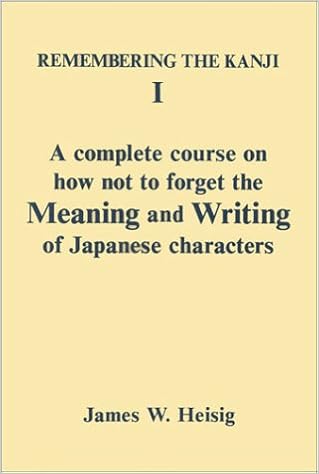
It was in 1997 while I was studying in Japan that I came across the book. I was still in this “I must write every new character a million times every day” frame of mind until I came upon this system, and after discovering it I abandoned the traditional approach forever. The book ignited my imagination and unleashed its energy on Chinese characters. Heisig’s system ensnared me immediately, but surprisingly, the more I studied the method, the more I found myself dissatisfied with Heisig’s mnemonics and devising my own. I bought a copy and wrote all over it, “correcting” it for myself. Personalizing it, you might say. Heisig would have approved.
I didn’t stay with the system forever. I never learned a mnemonic for every last character. There just came a point when everything sort of “clicked,” and memorizing characters wasn’t difficult anymore. Sure, I would forget characters (and I still do), but every time I’d forget one and have to look it up, those old mnemonics returned to me and helped lock that character back in my memory. The important thing is that I never had to write characters over and over again. I’ve passed various written Chinese tests without ever having to do that. I have been able to make better use of my time and of my mind.
Occasionally I would come upon a character that resolutely defied my memory. If the character mattered to me, it would get “special attention.” That meant setting aside some time to deconstruct the character, research the etymology (sometimes, but not always, a helpful practice), and apply some imagination. It might take as long as 20-30 minutes for just that one character, but eventually I would come up with a memorable story mnemonic involving the character components, tailor-made for me. And then I would not forget the character again.

In short, Heisig’s book totally changed the way I approach characters. It’s a triumph of imagination over rote learning. I am very grateful to him for that. If you’re trying to learn Japanese or Chinese, I strongly recommend you get Remembering the Kanji.
See also: Adventures in Kanji-Land: James W. Heisig and the Birth of Remembering the Kanji
You’d be surprised at the number of people who think that Heisig’s method is totally unnecessary and detrimental.
Heisig’s Remembering Simplified/Traditional Hanzi will apparently be released soon.
“Learning Chinese Characters” but IMHO looks even better than Heisig’s Hanzi books. Heisig for some reason decided not to include the pronunciation of the character, but Learning Chinese Characters includes mnemonics for the pronunciation and the tone. Available now , but only for the first 800 characters in volume 1. Can’t wait for Vol 2.
Seems to have taken a very long time for “Heisig method” books to be published for Chinese, I wonder why.
PS Keep up the good work at Chinesepod.
Simon, the link to “remembering the hanzi” is not working, just letting you know. And thanks for the second amazon link, looks pretty good. Considering ordering it.
@Eric: That’s strange, it works for me. Here is the url.
http://www.nanzan-u.ac.jp/SHUBUNKEN/publications/miscPublications/Remembering%20Hanzi%201.htm
Oh, weird, now both are working for me. I’m sure it’s some dumb mistake I was making. Either way, thanks for the referrals!
I would second the Learning Chinese Characters book by Matthews & Matthews … using that alongside Wenlin is forcing characters into my head faster than every before.
I couldn’t stand Heisig when I was learning kanji. I used Henshall, and basically just made flashcards for all 1945 jōyō kanji. This approach worked great for me, but I’ve found that I have a stronger stomach than most for rote memorization.
Happily awaiting “Remembering the Hanzi” here in Sichuan….
…also, reading the introduction to the books (available in the free pdf previews) will show why phonetics aren’t introduced until later. It really makes a lot more sense in the long run.
John, you accomplished what Heisig really wants all of us to do, and it’s to “make the characters our own” so to speak.
Thank Heavens, I was starting to think I’m completely mad, making up memorization patterns and sometimes linking characters and components to fictional explanations. I am Italian, and though I have passed that stage, from time to time I still see in 方 soccer player Montella doing the airplane after he scores.
I loved that book!!!! I also found some books which helped me in China; Chinese characters in Pictures and What´s in a Chinese Character
In Japan, naturally this kind of books neither sells nor exists, perhaps. Instead, there are a lot of hilarious “how to remember English words” books. I myself have never read any of them, simply because I feel that memorizing “mnemonics” is much more cumbersome, or unmemorable, for me than directly memorizing words. I have a poor memory, so I can’t afford to memorize both mnemonics and words.
Japanese children generally memorize Kanji mechanically, without caring much about the meaning of radicals and stroke orders. It is a typical rote learning. Consequently, most Japanese people don’t even know the names of radicals, much less etymologies of Kanji. I think the best way to memorize English words or deduce their meanings would be to learn their prefixes and suffixes originated in Latin and Greek.
“In Japan, naturally this kind of books neither sells nor exists, perhaps.”
Right. They start drilling in kindergarten, and spread over 12 years what we can do in a couple months. 🙂
Finally, haha, nice to read this post. Yes, it does have a scientific knowledge in the character system, but I doubt if it’s smart to learn in that way. Repeating the characters is always the stupidest shortcut, works for everyone.
Heisig is EXACTLY how I learned my Kanji…and it’s stuck for over 3 years now!
By far the best method I’ve ever tried IMHO 🙂
Hi John,
I speak chinese, and just started japanese, and I was thinking of no focusing too much on kanji, that it would come along, just needed to read books with furigana for examples. But now i am thinking of maybe using Heisig’s method.
Would you recommend this book for a beginner in Japanese who already know Chinese?
If the Heisig approach is such great learning technique, why not integrate this into ChinesePod??
yangbin,
I found it easier to, as you said, not focus on kanji and let it come along naturally. It was much easier to learn kanji for spoken vocabulary I already knew.
I just ended up here after following a few links looking for where I can buy “Remembering Simplified Hanzi Book 1” and book 2. There’s a couple of samples available as PDFs if anyone wants to have a sneak-peak. I’m sure the Japanese would be available as a sample as well. They are both roughly the same, with the first 20 or 30 pages being identical as they are simply the introduction. I still haven’t found a link to where to buy them but here are the links to the sample PDFs for the Chinese ones:
Traditional Hanzi Sample:
http://www.nanzan-u.ac.jp/SHUBUNKEN/publications/miscPublications/pdf/RH/RK%20Traditional-sample.pdf
Simplified Hanzi Sample:
http://www.nanzan-u.ac.jp/SHUBUNKEN/publications/miscPublications/pdf/RH/RH%20Simplified-sample.pdf
Ahh.. upon further investigation I can see that these new Hanzi books are brand new to the market and are being released at the end of October! Woo!
From the website:
PROGRESS REPORT (17 October 2008):
The books have been printed and are schedule to be at the
binders on 24 October. They should be ready for shipping
within a few days after that.
It’s exactly the same style.. so soon we will be able to use this same awesome learning style to learn Chinese as well. Here’s the proper link to the site:
http://www.nanzan-u.ac.jp/SHUBUNKEN/publications/miscPublications/Remembering%20Hanzi%201.htm
Didn’t see this one before the others.. silly Google.
[…] a year ago, John at Sinosplice wrote an article about how he first really learned Japanese Kanji, with a book called Remembering the […]
The chinese version “Remembering the Hanzi Book 1” has been released via Amazon. It has, as mentioned earlier, the Simplified and Traditional versions sold separately.
I’ve just gotten my hands on a used copy of RTK myself this week and I’ve been enjoying it quite a bit. The only frustrations so far are
1) Some character distinct character components lost their distinctions during the post WWII character simplifications, making Heisig’s stories a threat to my Chinese writing ability
and
2) Some of the stories are too contrived to remember
However, the technique is great and having so many vivid stories to pull from are a great help. I don’t think I’ll ever have to suffer as much in trying to memorize characters again. It’s still going to take a bit of work to make the mnemonic stories in the first place though.
Just dropping back with an update. I’ve been enjoying RTK far more than I would have imagined. During the last week of my winter break, I put about 45 minutes into making Kanji stories each day, and I’ve put about 20 minutes a day into it since that.
I’m already up to 1000 kanji and I’m writing over 95% of them correctly on the first try. I’m absolutely dumbfounded by how much more solidly the characters are sticking in my head than ever before. Thanks for the post!
(I might suggest implementing a “remembering the blog” mnemonic for you though)
[…] volumes) are mainstays among students of Japanese (John Pasden wrote about his experience with it here, and Mark from Doubting to shuō wrote about using it after having studied Japanese and Chinese for […]
Does book 2 actually exist? It’s mentioned on Amazon.com but I can’t find it on the web
I wrote to Mr. Heisig, here is my letter and his reply……..
Sent April 3rd 2010:
Replied yesterday April 4th 2010:
Thanks for this information, Ray!
(The formatting of your original comment was all weird, so I cleaned it up for you.)
“A triumph of imagination over rote learning.” I like that 🙂
I became a big fan of Heisig when I lived in Tokyo and it helped me decipher my overwhelming surroundings. So enthralled I became by his keywords that I longed to be able to write with them, just for kicks. So I made an app to do that: http://type.heroku.com/japanese (For instance, you just type “extinguish fire utensil” to get 消火器.)
I hope you like it. I’m learning Chinese now so I soon want to do something similar with the Remembering the Hanzi keywords, which would be perhaps more according to the subject of your blog. I wonder what happened to your Japanese learning. I seem to divine from reading your archives that you were learning it at some point and living in Japan, but then you dropped that in favor of Chinese? Or you “finished” learning Japanese? I ask out of curiosity because I’m also coming to Chinese from Japanese (in my case a shattered heart triggered the migration).
Take care,
-A fan of your blog 🙂
TypeHr,
Interesting!
I explain a bit about my background in Japanese in this post. I haven’t “finished” Japanese or totally abandoned it, but I get little Japanese practice in China, so my Japanese, while still serviceable, is definitely a bit rusty.
I just put my “Heisig Helper” app on the Android Market. If you have an Android phone, just search for “Heisig Helper” in Market or scan the QR code on the website heisighelper dot com. If people buy this app I’ll put one up for the Traditional characters as well.
UPDATE: App is now FREE.
Does it require Android 2.1 or something?
I’m still stuck on Android 1.5 for now, and it doesn’t turn up for me when I search in the Android Market. Based on past experience, this is probably because my version of Android can’t run it.
Broken link?
Heisig, SRS, and my experience with learning Chinese characters
http://globalmaverick.org/archives/213-heisig-srs-and-my-experience-with-learning-chinese-characters
[…] we use new ways of learning Chinese characters? Absolutely. But radicals, or variations of Heisig’s method are not new. Learning thousands of characters is not effortless however you slice it. But […]