
Variable Stroke Order in Chinese Characters

I started learning Japanese in 1996. When I began learning Mandarin in 1998, I already had a foundation in Chinese characters, thanks to my Japanese studies. Learning the two languages at the same time, I was frequently annoyed by little discrepancies such as 歩 and 步, 別 and 别, 氷 and 冰, etc. Those little character details caught my attention, though. I ended up writing my senior thesis on how and why the Chinese characters of the Chinese and Japanese writing systems ended up diverging.
One little detail that always nagged at me, though, was stroke order. The truth is, stroke order of Chinese characters is not consistent across Japanese and Chinese. I was reminded of this recently by Tae Kim’s blog entry entitled, What’s the stroke order of 【龜】? Who cares? He brought up the stroke order of the character 必 as an example of a “weird character.” This character just happens to be one of the ones whose correct stroke order has been ever so slightly bugging me all these years.
必 is a great example, because it shows up in plenty of relatively simple words in both languages, like 必要 (necessary) and 必须 (must) in Chinese, and 必ず (without fail) and 必要 (necessary) in Japanese.
Now let’s take a look at the stroke order of this simple character. I’ll have to assign letters to each stroke so that we can keep the different stroke orders straight:
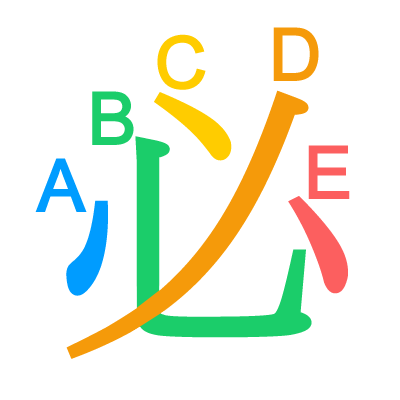
Chinese 必:
– Ocrat, MDBG, and Wenlin all say A-B-C-D-E.
– Learn to Write Characters (click on 必), maintained by Dr. Tim Xie, says A-B-C-E-D.
– A-B-C-E-D makes a lot of sense to me, because the character’s radical is 心 (but that doesn’t necessarily matter at all).
– Remember that Chinese has the added excitement of the simplified/traditional divide, as well as other regional differences in the mainland, Taiwan, and Hong Kong.
– If you have more to add to this (especially from more authoritative sources). please leave a comment!
Japanese 必:
– WWWJDIC, Kawatsu, Kodansha, and Gakken all agree on the bizarre C-D-B-A-E.
– It’s almost as is they’re writing 义 first, then adding “wings,” but no, the radical here is 心 as well. (We can see why Tae calls it weird.)
Hmmm, that’s a lot of inconsistency. Gives you more respect for the people that can create good Chinese handwriting recognition software, doesn’t it?
But wait! It doesn’t end there. An even simpler character — 出 — behaves inconsistently as well. I’ll spare you all the details and jump to a diagram taken from a very interesting tool I found illustrating various stroke order differences:
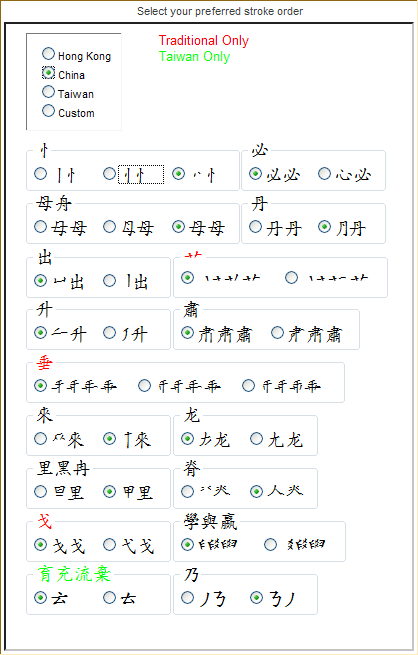
Note that aside from the incredibly common 出, the heart radical 忄 — a component of tons of very common characters — is also among the ambiguously stroke-ordered. Notice too that the Japanese-only variants are not included in this list.
So what’s my point? Well, it’s not any of the following:
– Chinese is really hard
– Chinese characters are really complex
– Chinese characters are hard to learn
– Chinese character stroke order is fun!
Chinese is not semi-mystical. Chinese characters were created by people a really long time ago, and thus it is an amazingly imperfect, inconsistent system. East Asian brains aren’t semi-mystical either; with all these differences going on you can bet that the Chinese and Japanese get mixed up too. In fact, armed with the chart above you’ll find it really easy to spark debates with very literate Chinese over the “correct stroke order.”
Like me, you may be bugged by these inconsistencies. You may feel compelled to seek out some underlying pattern or just memorize a big list of exceptions. Don’t do it! Be satisfied with a quick look over the chart above. Just get the non-exceptional stroke order basics down and you’ll be fine, trust me. Don’t obsess over perfect stroke order and all the exceptions, because it’s an imperfect system. The deck is stacked against you. Learn to read and use characters to communicate, and you win.
Hi John,
Thanks a lot. It’s a great and intriguing article, as always. I fully agree with you. Being obsessed with so-called “authentic stroke orders” is just ridiculous. What you need is to follow some basic rules, such as “top to bottom” and “left to right”.
The most laughable example is 右 and 左 in Japanese. Look at the following pages. Why are they different from each other? I guess there might be a profound calligraphical reason behind that. I don’t know their most orthodox stroke orders in Chinese. Do you know them?
(右) http://www.winttk.com/kakijun/1/10002.htm
(左) http://www.winttk.com/kakijun/1/10024.htm
The most important thing about strokes is NOT what stroke order to write a character in, but how to count the correct number of strokes in a Chinese character, which is vital when you look up in a Chinese dictionary. If you can’t get a correct stroke number, your stroke orders are absolutely wrong.
changye,
Ha ha, I remember learning the 右 and 左 stroke orders in Japanese years ago. I remembered them with this mnemonic: “左 starts on the left, 右 starts on the right.”
I agree that stroke count is more important, but in this digital age it’s getting less and less vital. These days almost everything I look up is done digitally via copy and paste… 🙂
Yeh.. I’ve never really understood the massive emphasis on stroke order myself. I haven’t learnt how to write and can barely read hanzi but even so I am more concerned with 1. Identifying the ‘count’ as changye suggests, and also 2. Identifying the radical(s) that make up the whole.
From a digital point of view, I am more concerned with the pinyin as that is how I input using the IME. The pinyin has a two-fold benefit in that it contains the english pronunciation of the character. To me the character represents the pinyin, rather than the other way around. For example the symbol @ stands for ‘at’, or the symbol 3 stands in the place for the word ‘three’.
May be that’s my western mind trying to make sense of it all but ultimately, stroke order has extremely low relevance to me. It’s a fascinating topic, that’s for sure but that’s all.
Very important for serious students of the Chinese language to know this to avoid confusion when encountering alternate stroke-orders, or when being told that the stroke order that one learned correctly is “wrong”.
I hope fellow readers will not think that John is saying stroke order is not important.
If a student wants to learn to write Chinese by hand, it is important to stick with one of the correct stroke orders. It is easier to remember something you do the same way each time. Not only is it easier mentally, but “muscle memory” kicks in and helps too. Inattention to stroke order could be one factor in a person never learning to write Chinese by hand.
Two other reasons stroke order is important to a serious student:
Eventually, one’s characters can become cursive. At that point, a correct form of stroke order will keep the characters recognizable.
Finally, stroke order is a part of the language’s “culture”.
I have found it important to know the general rules (top to bottom, etc.) AND to learn the details for individual components and characters that the general rules don’t really make clear. Also, I know that I sometimes make mistakes.
I think the point of John’s very helpful post is that stroke order systems are not perfect, not that stroke order is unimportant.
I guess it’s harder to standardize stroke order in one of the largest countries in the world. I think the stroke order for Japanese is pretty consistent within itself. One odd inconsistency I noticed wasn’t even Kanji but も. For 左 and 右, I didn’t even bother learning the “official” order and just use the same order as 友. Stroke order in general is important but you have to pick your battles and let some minor things slide.
By the way, those minor differences annoy me too! I recently realized 単 was different in Chinese and was writing it wrong for the longest time.
Finally, 必須(ひっす) is used in Japanese as well though not as common as the Chinese version.
Well, I write (not sure whether I learned it that way, though) 必 ABCDE, simply because it’s normal to write form left to right. I pity those little schoolkids (by the way, yesterday I read an article of an English language newspaper about Chinese schools, referring to the pupils as abecedarians!) who have to grapple with these subtleties, but we’ve all gone through the same process. Perhaps I got more than my fair share because my father is an avid calligraphist, albeit only on a leisure time basis. I have never been fond of rote learning, so I resisted most of those educational formalities. No wonder I didn’t get into a prestigious university.
Regarding the importance of the stroke order, if you practise calligraphy or, more likely, start writing cursive script(that is, not “copying” computer font but have your own handwriting), you should pay attention to the proper order, otherwise your characters could look weird and might not be recognisable. But that’s only in extreme cases.
But: Once, during a lesson, wrote something in big characters on the board. My usually dead silent students began to whisper. I turned around and inquired about the source of their confusion. No one dared explain but I found out later that they were amused because I’d got the stroke order of 极 (as in 基极) wrong…
A question for changye and other speakers of Japanese – apart from the 右/左 issue*, are there any more bizarre stroke orders like abovementioned 必? Don’t you get immensely confused (I mean, even more than the occasional bewilderedness about one’s own mother tongue) or are the underlying basic rules very different from Chinese?
(And let’s please ignore that I called my dad a calligraphist instead of calligrapher. Why on earth are there so many different endings for nouns that describe a persons job or pursuit? Greek roots? Latin?)
Interesting. I had the same experience when first studying Chinese (after completing a B.A. in Japanese language). The first characters that really got me were 生 and 田. It seems that in both cases my Japanese teachers preferred vertical before horizontal and my Chinese teachers visa-versa.
Oh, and that “very interesting tool” crashes my firefox!
Like Mark said, it crashes Firefox for me, too! I was loading the page, and then it disappeared, and I was like, “Huh?” Then, I tried it again, same result. Try Explorer, I suppose?
I got annoyed with the stroke order when I found that some of my books mention there being several different ways to write a character, even some that seem rather simple. So, I’m glad I’m not the one who’s been having trouble with “必.”
Thanks for this one!
It truely deserves to become a CPod lesson – spread the word out to all the other learners.
Nooo! Internet Explorer shuts off, too! Maybe American computers don’t feel like studying Chinese characters. Any way to get around the browser crashing?
Anyways, I go ABCED.
I was told that if you get the stroke order wrong, then native speakers can’t read your writing. I never understood this, if it looks the same, then it looks the same. Any enlightenment on this one?
I have one of those pocket-sized folding electronic dictionaries, which I use to look up Chinese words by writing them on the LCD screen. The software used for character-recognition is apparently quite stroke-order-sensitive– even for relatively simple characters such as 口 (mouth). You can draw a perfect square in the box, but if it is the wrong stroke order, then the dictionary will not only not recognize it, but 口 will not even be included in the list of “closely-related second-choice characters” it shows.
Makes me thankful that my teachers at the Univeristy of Texas a few years back were strict about teaching correct stroke order 🙂
Some great comments here! Sorry for being slow to respond. Time to clarify a few things…
Alaric,
YES! It’s definitely important to get the basics down. Just don’t obsess over the types of inconsistencies I’ve outlined in the post.
This point relates to what Scott in Tainan writes:
Scott (and krovvy), it’s not that the software can only recognize characters written in the correct order (theoretically, the software could recognize any order at all). The real issue is that when Chinese people write in a more cursive script, the strict form is lost, and it’s the stroke order which enables the program (or the reader) to recognize the character.
As a native writer of Chinese who recently started to learn Japanese, stroke order is something that’s already internalized through years of writing, and I don’t really think about it consciously when I write.
So when I’m taught a Kanji that’s not used in Chinese (mostly because it’s in traditional script), I’ll usually try to remember and visualize it in terms of the radicals that it’s made up of, and being able to reproduce each radical usually means you get the stroke order correct.
Having said that, writing Kanji like 飛 and 機 do pose a real challenge, as I can’t say I’m 100% sure of their stroke order.
In any case, I don’t think there’s a need for an attempt to standardize the stroke orders across both languages since what matters most is frankly how the characters turn out eventually. And as you mentioned, there’s no standard even within Chinese.
“…The software used for character-recognition is apparently quite stroke-order-sensitive…”
Of course, I wasn’t referring to character-recognition software in GENERAL (because I know absolutely nothing about the subject!), but rather about the software used in the particular dictionary that I have, which is the Besta brand.
Different brands probably use different software. The one I have relies more on stroke order than on form.
I keep wondering when dictionary brands like Besta are going to start producing electronic dictionaries that are easier for non-Chinese to use and marketing them outside of Asia.
I tried using PlecoDict on my Palm PDA, but I finally lost patience with having to re-boot and re-install everything over and over. My new dictionary cost about $63 US, and fits in a pocket.
‘stroke order’ had been a nightmare for Chinese and means little important.
I am Chinese born in 1926. I started practising caligraphy since nine years old. A majority of Characters are very complicated for me to follow the stroke order when I wrote.
In the computer era, writing is much less a must. The keyboard can do much much better writing job instead. I have no objection in the study of ‘stroke order’ However, I thought of that the brain being used to remember it would be a waste.
chih yuan cheng
publisher
Global Net Daily
http://www.upilot.idv.tw
Tel:886227970387
Email:chih_yuan_cheng@hotmail.com
There are many Japanese Characters and Chinese Characters being same in their layout but with far different meaning.
Very interesting. I never thought there are different orders.
This link (below) is a really interesting insight on language learning in schools. “Why language classess don’t work”
(I did three months in a supposedly good school here in the PRC, only to be very dissapointed)
As I run a language school, although more innovative and unique than most, I know I am shooting myself in the foot here – Ha ha
Some great tips though…
http://www.fourhourworkweek.com/blog/2008/09/22/why-language-classes-dont-work-how-to-cut-classes-and-double-your-learning-rate-plus-madrid-update/
not quite sure where the little dot in 機 (ji) goes please help
You might be interested in what Johan Bjorksten says on the subject of 必 in “Learn to Write Chinese Characters” (Yale 1994, ISBN 978-0-300-05771-3).
I found this slim volume from my local library with a view to improving my handwriting speed and aesthetics, because I know my stroke order is pretty ropey. It also helps with understanding native speakers’ semi-cursive handwriting.
Anyway, Bjorksten says the official 楷书 kaishu (standard script) stroke order is A-B-C-D-E. But he suggests that this stroke order makes it difficult to compose a “harmonious” character, and suggests instead the stroke order D-B-C-A-E. This, he says, is the 草书 caoshu (grass script) stroke order. It certainly seems more efficient to write it in this way.
This, he underlines, is one of the few exceptions of calligraphic licence with kaishu stroke order rules. I wonder how common these alternatives are in the normal handwriting of Chinese people. Thoughts?
Martin,
Interesting… I checked a book on 草书 characters that I have, and while it doesn’t give the exact stroke order, the visibly connecting lines seem to affirm the order you give: D-B-C-A-E.
This is also closer to the Japanese variation, just putting C after D-B rather than before.
I don’t have any other thoughts, except that this doesn’t seem to bring much clarity to an already muddled issue. 🙂
i agree with the aforementioned explanation of the most striking irregularities in the three characters 左, 右, and 必.
as for the first two 左, 右 i think the real mishap is not that they look similar and are written differently, but that two characters that used to picture a left hand (plus something) and a right hand (plus something) have become extreme abbreviations of whatever hand (plus something).
given that throughout most of history and up to today handwriting (xing and cao) was of utmost importance for written communication (witness the volume of handwritten, then mimeographed books that were published even in the 20th c), it becomes clear that it is exactly the differences in stroke order that have aided in keeping 左 and 右 apart, and this strokeorder has been handed down in history more faithfully than the printed appearance. so yes, insisting on correct order in this detail is negligible for most students, but becomes important once you want to acquire a more flowing, elegant, and readable hand.
the last remark also goes for 必. you say that C-D-B-A-E is weird, since there is clearly a heart radical. well, historically, there is none. http://chineseetymology.org says: “Separation 八 of dividers 弋. 分極也從八弋弋亦聲”. what you do when writing C-D-B-A-E is you take 弋 and tilt it to the left a tad, effectively turning the horizontal into an oblique stroke (which must be written topright to bottomleft), and its like you rotate the strokeorder, starting with the dot 丶丿㇂ then like smash the 八 over it (and actually scream with each dot). i know its real weird but the outcome is something that makes characters like 愛 look just right (another weirdness: this should be 心+夂, but it looks much better when written as 必+夂 provided you write both left-falling strokes as one single stroke the way it is done in characters like 釜 and 識).
that seemingly innocuous characters like 田 have different strokeorders in china and japan comes, i guess, mainly from a difference in placing / enforcing calligraphic rules, from a few innovations that japanese calligraphers have come up with, and a few historical traits that got preserved in japan but lost in china (cf british vs american english which also show this bewildering mix of conservatism and innovation). it looks to me as tho japanese writers more often prefer to first write a vertical and then attach the horizontal strokes whereas chinese writers often (but by no means always and certainly not in xingshu) favor drawing horizontals first and to cross them with a vertical, always reserving a non-crossing horizontal for the very last stroke. for this reason, 田, 馬, 隹 and many other characters betray differences in chinese kaiti, chinese xingshu, and japanese kaiti.
i think the reallyreally important point here is that while the chinese are very tradition-oriented, they are also inventive. it is less important that students master each weirdness of strokeorder, it is much more important that they first learn what few people ever challenged, then go on to discover how to break the rules—and be admired for the beauty of it. this is an important goal because even and especially rulers of the state get very much judged in china by the way their handwriting looks like.
I have used Arch Chinese(http://www.archchinese.com/arch_animation.html) for a while to learn how to write Chinese characters. The character 方 caught my attention today. The last stroke is pie2 instead of hen2 zhe2 gou1.
歐楷解析 by 田蘊章 says that 歐陽詢 (a Tang Dynasty calligrapher known for his 楷書) used DBCAE for 必.
[…] I do, wonder, though, what kind of stroke order information is freely available out there that could speed the process along. I’ve seen enough separate sets of animated characters to make me suspect many have been automatically generated. (Anyone have info on this?) I’m also curious how the project is going to deal with the annoying issue of variable stroke orders. […]
I respect the comment of chih yuan cheng, August 27, 2008 at 9:48 pm, about stroke-order rules. But it seems to me that they were worth learning, and I quickly ingrained them via strict discipline from the beginning.
I think it’s a good idea to pick a sufficiently authoritative and complete reference, stick with it, and avoid for a while interesting discussions such as the above! Around 2007 I chose the ABC dictionary via Wenlin. I later also bought Plecodict… because they licensed the ABC.
From the original post:
“Don’t obsess over perfect stroke order…”
You can learn them without obsessing by accepting that whatever authority you’re using has selected from legitimate competing options, that there is no perfect. By the way, it is necessary to choose and trust a font too for these same reasons; the people who craft the font must make similar judgments. Another reason I chose Wenlin was to get their in-house font, which is presumably consistent with their other decisions. (For appearance’s sake I use the simkai from Windows which is the best kaiti-style font that I’m aware of.)
“…and all the exceptions”
Don’t look at them; stick to one authority.
I just have to laugh at how weird my stroke order is; generally, I do have it right. However, I just noticed the Chinese/Japanese discrepancy for 生 and 田. Turns out I have Chinese for the left side, and tend to carry on that habit to anything with 王 in it and I have Japanese for the right one. The whole left/right one I just wrte the same way. Stroke order is important, but to me it is in a different way. It lets me be able to count the strokes to look them up, even if I am one off most of the time, and it lets me be able to write characters without them looking god awful the first time I see them. The last reason is that it builds muscle memory. I can’t tell you how many times I cannot get rid of the Vertical dashes before horizontal in the top part of, among lots of other ones, in 夢 just because it doesn’t feel like I’m writing it anymore. The one time I tried, I couldn’t even remember how to write it, and I knew I knew. And I love 靈 for how simple it is compared to the number of strokes. And now I have a very bad habit of forcing people to draw boxes a certain way. I wonder, if you tell someone in Japan to draw a box, would they do it, even if it is not Kanji, with correct stroke order?
四.一.一. 筆結
4.1.1. UPiLOTX+y
《筆結》即筆劃和筆劃連結點之簡稱,直堪稱之為中國文字之細胞。
UPiLOTX+y, equivalent to the basic cells from which the Chinese Characters are built stands for the joints of strokes of Characters.
筆結在哪裡?
Where are the cells?
經過多年研究,將漢字筆結,歸納出 一、十乂丁人厂凵尸口十大筆結,係由第二篇抽出之精義,即《字頭起筆》,乃由字頭分類統計之後,精簡濃縮出來的十個筆結之代表符號,繼之再將這十個符號予以編碼,由1、2、3、4、5、6、7、8、9、0、十個阿拉伯數字代表之,供中文行精準之檢索工作。
“UPiLOTX+y”, i.e., “THE STARTING STROKES”, are the ten symbols of the cells, derived and classified from The Statistics and Classification of The Prefixes which in turn are encoded numerically into 1,2,3,4,5,6,7,8,9,0 for precise SORTING OPERATIONS.
今舉‘般’字為例,其筆結一一用圓圈標示之。詳圖四.一.一. 方格坐標圖。
Making ‘般’ the example, each joint of strokes for the Character is marked with a circle on. Details are shown in Fig. 4.1.1.
圖四.一.一.FIG. 4.1.1. ‘般’ 字之筆結讀取順序座標圖
chih yuan cheng invented the stroke order as matrix does in algebra. all words in the world are composed from lines. line and line make knots which feature naturally as dots. which we can read in basis of matrix.
key word ‘upilot’ directs to my profile on google+
漢字檢索學 or UPiLOTX+y ISBN 978-986-843-190-4
The content of which gives full details of the definition of the cells of Chinese Characters.