
16
Dec 2006
AdsoTrans, ChinesePod Alliance
I mentioned last week that David Lancashire of AdsoTrans came to Shanghai on a visit. The “big secret” was that he was here on a mission. He was checking out ChinesePod HQ before considering a job offer. But all that is old news; as David has already revealed on his blog, he will be working for ChinesePod starting in January.
This is cool for many reasons. David has done a lot of amazing work on AdsoTrans (and News in Chinese), all as a hobby. He’s only one guy, but he’s one really smart guy, and he’s managed to put together a very impressive web app, as well as lots of other learning materials, all under the guise of “hobby.” He’s been translating in Beijing to pay the bills, but it’s clear where his passions lie.
Now he can get paid to do the same “fun stuff” at ChinesePod, but on a larger scale. At the same time, ChinesePod’s rather unimpressive “glossary” component is about to do a lot of growing up.
There are so many possibilities that I can’t go into, but let me just say that it’s really an exciting time to be doing what we’re doing. To the rest of the world we might appear to be just geeks into Chinese, but I think that a year from now we’re going to be able to look back and see that in 2007 online Chinese study got a whole lot better.
14
Dec 2006Windows of Deliciousness
The other day at work we discussed what I will call “windows of deliciousness” over lunch. A window of deliciousness is the period of time during which a certain kind of food is at its most delicious. Most hot foods start out at peak deliciousness, but once they cool down to a certain extent, they are no longer what could be termed “delicious.” The window of deliciousness for many types of food, from “straight out of the kitchen” to “too cold” might last 10 minutes or so. But there are exceptions.
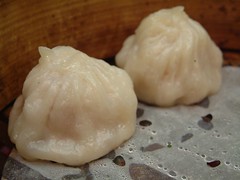
小笼包: dangerous dumplings
Take for example the Chinese 小笼包. These little dumplings are well known as one of Shanghai’s tastiest treats, but they’re also the culprit in countless consumption casualties. These little dumplings house a scalding dose of “soup” capable of melting the face off of unwary foreigners. The little dumplings are, admittedly, very good, but the wise always let them sit a little while before digging in. (The wise remember how long it took them to grow all those taste buds back.)
小笼包 have yet another special quality. If you let them sit so long that they get cold, they’re not good at all! This is where the window of deliciousness comes in. Due to their special circumstances, these little dumplings have a window of deliciousness of approximately 30 seconds. (OK, maybe 45.)
This got me thinking about western food, and how its windows of deliciousness might compare. I immediately thought of pizza, and realized that pizza is just as special in terms of window of deliciousness as 小笼包, but for the opposite reasons.

pizza: damn good
Freshly made pizza is delicious. Sure, the cheese might be hot at first, but it’s nothing like the lethal lava-broth that the tiny devil dumplings are packing. As pizza cools, it loses a bit of its deliciousness, but the story doesn’t end there. You take the uneaten portion home and plant it in your refrigerator. In that wintry cocoon your pizza undergoes a miraculous phase transition. It is no longer just “pizza.” It emerges from the metamorphosis an entirely new animal: leftover pizza.
Leftover pizza is different because you eat it cold. In that state, its window of deliciousness has gotten a second wind, which fades only as the pizza once again approaches room temperature. That’s not much of a concern, however, because the chances are good that the pizza will never survive that long. Let me reiterate the important point: pizza has two windows of deliciousness, both of respectable length. This is frickin’ amazing.
I can’t confirm it quite yet, but I think this research may lead directly to the ultimate, incontrovertible triumph of western food over Chinese cookery. I am quite certain that when faced with this new evidence the Chinese will gracefully concede defeat in this long and bitter war of the cuisines.
13
Dec 2006Mandarin Tone Tricks
I recently got an e-mail from Albert Wolfe, the guy behind Laowai Chinese. In the blog Albert shares his experiences learning the Chinese language. He has lots of great observations that I recommend any beginner take a look at.
What especially caught my attention was a recent post on tones. This is because Albert has employed some of the same tone mnemonics that I myself devised and relied on once upon a time.
Albert writes:
> Once you learn how to say each tone, then associate some emotion with each one. For example, here’s my own personification and characteristics for each tone:
> 1. 1st tone = transcendent, helpful, simplicity.
I love words that have the first tone because of their simplicity and how easy they are to sing out and pronounce correctly.
> 2. 2nd tone = insecure, unsure, questioning.
I sympathize with words that have the second tone because I’ve been unsure and insecure myself. I don’t blame them for sounding like questions.
> 3. 3rd tone = mischievous, mean-spirited, illusive, like a bird you’re trying to watch but he dives into the water and pops up where you aren’t looking.
I hate words with the third tone. They take more work and more time to pronounce. They change depending on the words near them. They seem to exist only to make my life more difficult.
> 4. 4th tone = angry, demanding, impatient.
I also like words that have the fourth tone because I can shout them out. These words give me a chance to vent. Usually, as a default, if I don’t know the tone of a word, I’ve found I’ll say it as a fourth tone involuntarily.
11
Dec 2006HSK for Inmates
I hear a lot of foreigners in China saying things like, “I need to find the right method of learning Chinese,” or “I need to find the motivation,” or “I need to find the proper environment, free of distractions.”
It seems that a few enterprising foreigners have figured it out.
Via Hank.
09
Dec 2006Of House Guests and Empty Rooms

David
David Lancashire of AdsoTrans fame is in town this weekend. He wrote a little about Shanghai in his new blog.
My roommate Lenny is leaving Shanghai for Taipei tomorrow (with his new t-shirt!). I’m moving out of this apartment in early January. It’s been a great place, and I really like having the extra room for guests. These past few months we’ve had lots of visitors, like Mark of toshuo, Poagao, Alf, Greg (house guest extraordinaire), Lenny’s sister, and now David.

Lenny
This “free hotel” business isn’t going to last much longer, but until I move into my new place, I don’t mind it at all. With Lenny gone, this three bedroom apartment is going to seem quite empty.

06
Dec 2006The Humor Vacuum Sucks
TalkTalkChina is gone, and there’s a bit of a humor vacuum in the China blogosphere. Who’s going to help fill it?
– Greg of Sinobling is writing again. His new post entitled So What You’re Saying is You Don’t Have a Liver for Me is hilarious.
– The TTC heir apparent seems to be Sinocidal. The similarities are many, but I haven’t seen anything quite on par with TTC’s greatest hits. The Flopsy entry got my attention, though.
– Yellow Wings apparently has some kind of relationship with Sinocidal. The entry entitled How to write a China-related weblog was amusing, but I just couldn’t figure out which type of weblog to identify with… hmmm.
The last two are rather recent additions to the China Blog List. Since good China humor seems to seethe with negativity by default, I’ll balance it out a bit by finishing with a link to 10 reasons why living in China is great from another new one called Positive Solutions. But it’s not funny. Oops.
04
Dec 2006Alf, Lord of the Dolphins
Have you heard of the Chinese river dolphin? The Guardian recently wrote a story called
On the trail of the Yangtze’s lost dolphin. By “lost” they mean “likely already polluted into extinction.” (Whoops… who could have predicted what whacky side effects repeated dumping of untreated chemical byproducts into a river could have?)

Alf on his Quixotic mission
The species may already be long gone, but that hasn’t stopped an international expedition from getting out there and trying to find it. My friend Alf actually joined said quest. It is as yet unclear whether their efforts are all in vain.
Alf, at least, got himself featured in the Guardian. Check out image 04 of the slideshow and you can see him peering through a pair of comically large binoculars. (Ladies, check out image 14 to see a Chinese fisherman with a physique rivaling Bruce Lee’s!)
Thanks to Heather for the links.
02
Dec 2006Lin Danda
Commenter Marco e-mailed me this great visual Chinese joke (translation and explanation follows):
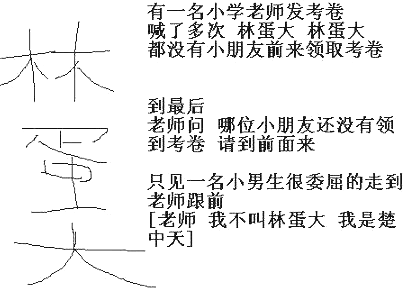
Translation of the joke (and you do need the visual above to understand it):
> A primary school teacher was returning test papers. She called out again and again, “Lin Danda! Lin Danda!” But none of the children came forward to collect the test paper.
> Finally, the teacher asked, “is there anyone that hasn’t gotten a test paper back? Please come to the front.”
> One little boy unhappily approached the teacher at the front of the classroom. He said to her, “Teacher, my name isn’t Lin Danda. I’m Chu Zhongtian.”
Sorry, if you can’t read the Chinese characters, there’s nothing to get. For those that want the explanation, read on.
30
Nov 2006Wrong Gong
As I’ve mentioned before, I’m sort of married. I see it as a year-long process beginning with a legal marriage and ending with a religious and social ceremony. Between point A and point B, however, is the acquisition of a new residence. Perhaps more significant is the subsequent decoration of said residence. This has been keeping us quite busy for the past month.
In China if you buy a new apartment (OK, I know it’s not really an “apartment” if you “buy” it, but this is what I say), it comes as an empty concrete shell. No drywall, no internal wiring or plumbing, no nothing. This condition is known as 毛坯. Starting from such a husk is a lot of work, because you have to design everything (or hire a designer), and you have to hire a contractor to get all the labor done. It also brings a lot of freedom, though, because you’re literally free to do anything with your apartment, short of knocking down key structural walls or tearing out the building’s shared plumbing or wiring.
So my wife has a pretty cool vision for our new apartment. It’s sort of an adapted “Mediterranean” design. That means it incorporates arches in some places. There are many things my Chinese is not yet good enough for, and architecture is certainly pushing it.
It appears that in Chinese, an arch shape is usually referred to as a gongxing, a word that, until recently, I was unfamiliar with. When I hear a new Chinese word, lots of things happen in my mind:
1. My brain checks it against all the vocabulary I know or might have once known
2. My brain factors in the possibility of southern-accented Mandarin distorting a word I know in proper Mandarin
3. I analyze and note the tones
4. Given the context and my understanding of the meaning of the word, I try to mentally match the syllables with appropriate Chinese characters I know
In this case, checks #1 and #2 were not helpful. When I got to step #3 I focused on the fact that xing was definitely second tone, so must be 形, meaning “shape.” It just made too much sense to be wrong. Without paying much attention to the tone of the gong syllable, I moved on to step #4. I decided that what made the most sense was the character 弓, meaning “bow.” In this way I concluded that the word we were using for “arch shape” was 弓形 (tones: 1-2).
It was a reasonable guess. 弓形 is, in fact, a word. According to Wenlin, it has the (very logical) meaning of “bow-shape” and “curve.” In math it can also mean “segment of a circle.”
I got away with saying gōngxíng (tones: 1-2) for a while, and somehow remained blithely unaware that everyone around me was saying it slightly differently. My wife is not my Chinese teacher and really never has been, so she rarely corrects me. She corrects me when my mistake is so blatant that it pisses her off, or if it’s a chronic error that eventually gets under her skin. Such was the case with my “gōngxíng.”
“It’s gǒngxíng,” she told me finally. “Gǒngxíng!” (tones: 3-2).
I looked it up later. The dictionary showed me 弓形. And it showed me 拱形, meaning “arch.” An architectural term.
It’s little incidents like this which firmly cement a word in one’s memory.
28
Nov 2006Rock, Paper, Scissors: the Store!
Over the weekend I noticed this home decor store:

The name is 剪刀·石头·布, which translates literally as “Scissors · Stone · Cloth” and more colloquially as “Rock, Paper, Scissors!” Cool name.
I must take issue with the logo, however. It depicts two hands, which appear to be in scissor and (very weak) paper mode. Where’s the rock? It’s the best! To quote Bart Simpson, “Good ol’ rock. Nothing beats rock.”
Furthermore, there are hearts on the hands in the logo. Hearts? Come on. This shows a profound misunderstanding of the game (or perhaps an underlying cultural rift?). I mean, RPS is an international “sport” with a very competitive annual competition. It’s not about “love,” it’s about all-out psychological warfare. You gotta know your gambits. You gotta know your strategy, because “the game itself is as complex as the mind of your opponent.” The ignorance implicit in the above logo sickens me.
But speaking of crappy logos, the logo on the World RPS Society website is not. The crest on the left is not so noteworthy, but the graphic to the right is at once a nod to early Communist area dynamism as well as to Fountainhead cover graphic sensibilities. I like.
In conclusion: 剪刀·石头·布, your logo sucks, but your heart is in the right place. Rock on.
27
Nov 2006八荣八耻
人家发给我的短信:
> 《八荣八耻》
以关心老婆为荣
以忽视老婆为耻
以伺候老婆为荣
以麻烦老婆为耻
以赞美老婆为荣
以批评老婆为耻
以抢干家务为荣
以好逸恶劳为耻
以下班回家为荣
以夜不归宿为耻
以诚实专一为荣
以拈花惹草为耻
以遵守家法为荣
以违法乱纪为耻
以上缴工资为荣
以窝藏奖金为耻
我发出的短信:
> 《八荣八耻》
以关心老公为荣
以忽视老公为耻
以伺候老公为荣
以麻烦老公为耻
以赞美老公为荣
以批评老公为耻
以抢干家务为荣
以好逸恶劳为耻
以下班回家为荣
以夜不归宿为耻
以诚实专一为荣
以招蜂引蝶为耻
以服从老公为荣
以违法乱纪为耻
以上缴工资为荣
以疯狂购物为耻
26
Nov 2006Ziboy in the Flesh
Last Monday I had the pleasure of meeting Wen Ling (温凌) of Ziboy.com in the flesh. Although I interviewed him once upon a time, we hadn’t communicated much since then. I was happy, then, to get an e-mail from him out of the blue saying he was going to be in town and did I want to meet up.
I was hoping that he was going to show up with a camera around his neck, because the only angle I could possibly recognize Wen Ling from would be the absolute profile shot. (He never posts any other photos of himself.) He didn’t show up with his camera out–and in fact I never even saw his camera–but he had no trouble identifying me.
Talking with Wen Ling, I found out he has a personal connection to Shanghai. He thinks of himself as a Beijinger, but he actually spent some of his early years in Shanghai, his mother’s hometown. He even understands quite a bit of Shanghainese. Still, he wouldn’t want to live here. Beijing is his home.
There was one point in our conversation which, to me, made Wen Ling feel distinctly non-Shanghainese in his outlook. He told me he no longer works as a photojournalist, even though it paid well and he really enjoyed it. He quit the job because what he wanted most was to pursue his art. As a photojournalist, he simply never had time for it.
I know this type of person exists in Shanghai too, but they seem so marginalized here. Somehow in Beijing pursuing art is just natural…
23
Nov 2006Japanese Thanksgiving
Today was Thanksgiving. In years past I’ve gone to a lot of trouble to get a bunch of friends together at a restaurant serving an American Thanksgiving meal. It’s always overpriced, but it’s always good, and I like the Thanksgiving dinner enough that having it only once a year is woefully inadequate.
This year, though, I didn’t bother. Work is busy, and I just didn’t feel like calling all the nice hotels in Shanghai and being told of 300 or 400 rmb meals.
So instead, I got together with some friends and we did Japanese all you can eat. Despite rumors of “turkey sashimi” there was not a scrap of real Thanksgiving food to be found. I didn’t even stuff myself as much as I could have.
It’s always good to get together with a large group of friends (we don’t do it enough), but it’s getting harder and harder to “fake” Thanksgiving. I think I might just start holding off on the Thanksgiving festivities until my visits home to the States.
21
Nov 2006Tom Cruise Lingers on in China

Xitang
I visited Xitang in 2002. It was a little less famous then; it hadn’t even started charging admission for entrance through its gates. It was just one of many charming little water towns in Zhejiang Province, but it especially appealed to foreign and domestic tourists. The town was more than happy to accept the increasing tourism.
When Tom Cruise came to China to film Mission Impossible 3, part of the movie was filmed in Xitang. Xitang closed down for the filming. It had hit the big time.
One of my co-workers visited Xitang recently. He said its rustic charm is now “enhanced” by the posters of Tom Cruise everywhere. Curious, I had to do a search. This is what I found:
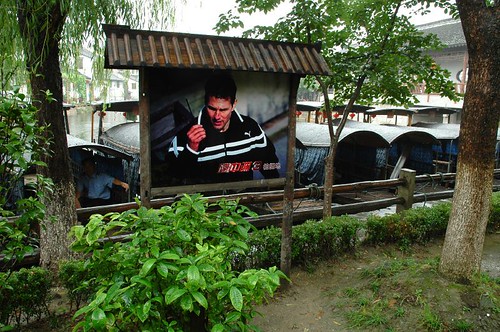
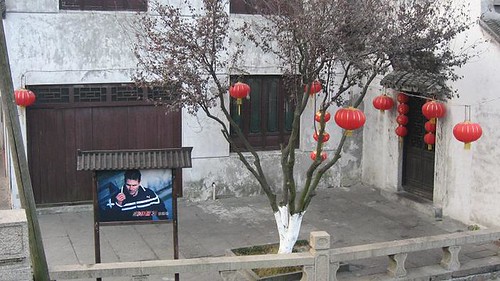
So now Xitang is “that little water town with pictures of Tom Cruise all over it.” This doesn’t bother me; it just amuses me somewhat. Things change, but everyone still just wants to make a buck.
19
Nov 2006Taiwanese Cuisine: Overrated?
Prince Roy in Taiwan:
> I consider it one of my biggest tasks to dispel the myth that Chinese food in Taiwan is ‘the best in the world’. It is one that many foreigners living in Taiwan buy into uncritically. For instance, in the No. 5 issue of Taiwanease, Albert Creak, author of the article “In Search of the Pu Pu Platter”, enthusiastically agrees with a guy named Mr. Lin who tells him: “Once you’ve tried the Chinese food in Taiwan, you’ll never want to eat at another American Chinese restaurant again.” Not only does this perpetuate a harmful vicious cycle which overrates the quality of Chinese food in Taiwan, it is woefully and demonstrably inaccurate. It’s high time we take off the blinders and face the truth: yes, Chinese food is good here, but it’s no great shakes, especially compared with the PRC, and it now lags behind the USA as well.
> I couldn’t have made this argument thirty or even twenty years ago, but the simple fact is that time has marched on and left the culinary world of Taiwan behind….
I’m not much of a gourmet. The problem is I tend to like most things I eat. I’m just not critical enough. The way I see it this works out in my favor in the long run, but it’s a reason I don’t normally shout my opinions on food from the rooftops. It’s interesting then, to see Prince Roy’s take. When I was in Taiwan I found the food good, but not amazingly good. The scene seemed similar to Shanghai’s: plenty of mediocre offerings, but also plenty of great food if you can afford it and know where to go.
18
Nov 2006So True
Meg at Violet Eclipse says:
> China is so safe, a girl could walk alone at night without worrying she’d be attacked or robbed. China is so dangerous, she might fall into a gaping hole in the middle of the sidewalk, left but the constant construction.
> Chinese people are the hardest-working people I’ve ever seen. People like Juice Aunt and her husband are outside with their cart, all day, every day, no matter what the weather is. But Chinese people are the laziest people I’ve ever seen. I’ve gone into restaurants and seen the staff asleep on the dining tables.
Read the whole entry.
17
Nov 2006Audio Resources for Advanced Chinese
I’d like to call attention to some work being done at ChinesePod, not because I work for ChinesePod, but because I think we’re doing good work for a specific learner demographic that is all too often neglected. Still, it seems like ChinesePod Advanced (高级版本) is not well known. For as much work as we’re putting into it, it deserves a little more attention.
15
Nov 2006Military Weaponry for Kids
Identify the theme that doesn’t belong in a series of books for Chinese children:
1. Cartoon Characters
2. Cute Animals
3. Mysterious Dinosaurs
4. Pretty Flowers
5. Means of Transportation
6. Military Weaponry
If you guessed #4, “Pretty Flowers,” you are right! The other five are themes of real coloring/drawing/character practice books in a series by Beijing Children and Juvenile Publishing House.
While we’re on the topic of Military Weaponry for Kids, let’s explore that book, shall we? Here’s what the book’s cover looks like:

The big name on the front is 画童学画, which could be cleverly “translated” as “Draw Child Study Draw.” Here’s what a few of the pages look like:


Each page basically does three things: (1) teaches the kid how to draw something across the top, (2) using pinyin, teaches the kid how to say the name of the object in the middle, and (3) gives the kid practice writing the character at the bottom.
Some observations:
1. The characters offered for writing practice in the book are at a kindergarten level, but the weaponry vocabulary is at a much, much higher level. (I don’t even know the names of some of those guns in English. Clearly I come from a totally un-war-like culture. Ahem.)
2. The part at the top that “teaches drawing” isn’t helpful. I used plenty of those “learn how to draw” books growing up, and this one just sucks.
3. Hey, this book is pretty useful for someone like me to learn weaponry vocab. Among the Chinese vocabulary taught in the book are: machine gun, heavy machine gun, handgun, rifle, semi-automatic rifle, uzi, revolver, hand grenade, flame thrower, rocket launcher, smoke grenades, tank, aircraft carrier, bomber plane, fighter jet, guided missile, stealth bomber… and more.
4. One of the guns is called a 来福枪 (lit. “come luck gun”). Hehe. Wenlin says it means “rifle” (a kind of transliteration) but it looks more like a shotgun to me.
5. Oh, right, I almost forgot: why do little Chinese kids need to be learning this stuff??
This kind of children’s book is not very uncommon; you can find similar books in almost any bookstore in China. (See the book here.)
Sort of related: see also Peer-See’s highly amusing entry on teaching incomprehensible weirdness to the children through bizarre blocks.