
16
May 2007
Grammaticalization: Articles for Chinese?
This week in grad school class about Chinese grammar, we covered the topic of grammaticalization. Of interest to me was one paper in which the author made a case for the demonstrative pronoun 这 beginning to take on the role of definite article in Beijing dialect. In this usage, 这 is pronounced “zhe” (neutral tone). The author also examined 那, and the same thing is not happening.
This made me think of English. We have the demonstrative pronouns “this, “that,” “these,” and “those.” Our definite article is “the.” Might “the” have evolved the same way? It seems almost the same… Just as 这 goes from fourth tone to neutral in the change, “this” perhaps lost its final consonant and the vowel was reduced to a schwa. Or actually, “the” could just be capturing the initial consonant sound of all four of those demonstrative pronouns. Does anyone know anything about the historical grammaticalization of English? I Googled it but didn’t find much.
The paper also talked about the development of an indefinite article (like “a” or “an” in English). The author explains that in Beijing dialect, 一个 is often shortened to 一, but is pronounced “yí” (second tone) rather than “yī” (first tone). It stays second tone because in 一个 the 一 has to be second tone due to Mandarin’s tone changes for 一. It’s not normal for that tone change to stick if you remove the reason for it, though. The author says this tone change sticks no matter what noun precedes it, and gives the examples of 一狮子, 一熟人, 一老外, 一耗子 (which demonstrate that the second tone sticks no matter which of the four tones follows it).
So it makes you wonder… if this trend in Beijing dialect becomes a rule, will it make it into Mandarin as a whole? How soon might students of Chinese have to learn the Chinese definite and indefinite articles?
The actual article goes into 11 pages of examples, as well as semantic and syntactic analysis. If you’re interested, it’s called 指示词“这”和“那”在北京话中的语法化 and it’s by 方梅, published in 2002.
13
May 2007How I Learned Chinese (part 2)
So I’ve already explained how I arrived in China with a decent foundation in grammar and characters, but some problems with my pronunciation. So what happened next?
Well, first I should explain my initial attitude. Two years previously I had had a great experience studying Japanese in Osaka. I enjoyed the process of learning a new language in a foreign society so much that doing it all over again had become central to my post-graduation plan. So when I arrived in Hangzhou I was very eager to get out there and try out my Chinese.
I immediately ran into two major problems. Overcoming those two problems were key to my early progress in China.
Problem 1: Pronunciation
OK, so I already knew when I arrived that my pronunciation wasn’t great. I knew I got tones wrong sometimes. I knew I had been fudging Mandarin’s “x” and “q” consonants for two years. But I wasn’t prepared for the end result: people frequently just plain didn’t understand me. At all.
At first I tried to downplay it with “that guy was just not used to talking to foreigners” or “it must be my Beijing-centric pronunciation.” That attitude didn’t really help me. I got through the denial stage pretty quickly and ended up with a firm conviction: the problem is me. I then gathered all my resolve and launched into a relentless campaign of self-criticism. Whenever I was not understood, I made a mental note of which words it was I seemed to be having trouble with. When people repeated what I said, I paid especially close attention, because they would often be correcting my pronunciation rather than merely confirming. I was totally focused on every word* that came out of native speakers’ mouths.
[*I have to make a note here: I initially lived in Hangzhou, a city in the southern province of Zhejiang. Southerners are notorious for their substandard pronunciation of the “sh,” “ch,” and “zh” consonants, but I knew this going in. It made listening comprehension very frustrating at first, but once I developed an ear for it, it became a huge strength. Having all that confusing input also made it absolutely imperative for me to look up in a dictionary every new word I picked up to confirm its correct pronunciation.]With the help of a Chinese friend and a lot of concerted effort, I was able to finally figure out how to pronounce “x,” “q,” and “j” consonants after about a month of living in China. I also hired a qualified tutor (she had a masters in teaching Chinese) to help me, and under her tutelage I finally got the “yu” sound down. The “r” sound eluded me for longer, but with focused observation and a self-critical attitude, I conquered it as well.
Tones continued to be a major problem for a long time, but they got better with time. The important thing was that I was convinced from my early experiences in China that they were very important and couldn’t be ignored. I was constantly looking up words in my dictionary, frequently just to check the tones. Once you’ve looked up a word about twenty times to check the tones, it usually finally sticks. Certain tone pairs gave me problems for a while, but when I began really focusing on tone pairs, I was able to overcome them as well.
Problem 2: Practice
One great thing about modern China is that foreigners are still rare enough in most places that it’s not hard to find someone curious to talk to you. I soon learned, however, that this does not necessarily mean that they want to talk to me in Chinese. I was meeting people at every turn that just wanted to talk to me in English. This was very frustrating. On top of that, even if their spoken English was pretty bad, my Mandarin was worse. So if our goal was actual communication, speaking in English was much more effective.
This did not deter me. I saw it as a challenge. What I had observed was that the people that wanted to practice English the most were young people, typically university students. Since they were about my own age and had a lot of free time, they seemed like the ideal conversation partners. However, I eventually had to make a decision to reject them categorically because they were nearly all obsessed with improving their English and I was in a hurry to improve my Chinese. It may sound cold, but I didn’t leave my friends and family on the other side of the world to improve strangers’ English. Teaching English was my job and I was dedicated to it, but in my free time I absolutely had to be practicing Chinese. I decided that language exchanges made no sense; I was surrounded by millions of Chinese. I was sure I could find Chinese people that would be willing to do an old-fashioned “exchange” of ideas and information–entirely in Chinese. And if unwillingness to communicate with me in Chinese was the thorn in my side, then inability to communicate with me in English could be my salvation.
So who did I turn to? Well, I reasoned that with my Chinese as bad as it was, if the conversation was going to be all in Chinese I would have to find someone very patient. That’s not an easy trait to spot. But what I realized is that people can be motivated to be patient if they’re extremely bored. So I set my sights on people who (1) were not in an age range or social status that were likely to know (or want to know) English, and (2) had a job which left them stuck in one place with no one to talk to… bored people.
So my first Chinese friends were the guards at the apartment complex where I worked. Those guys were aged probably 30-45, and sat in a guardhouse next to the gate all day long. Their only daytime duties seemed to be opening the gate for the occasional car and handing out residents’ newspapers. There was always one of them in there, just reading a newspaper or sipping his tea and staring off into space. I noticed that they seemed very interested in me. So I took the plunge.
It was weird and awkward to go into the guardhouse that first time and just start talking in my broken Chinese. I could barely form a coherent sentence. But when I made it clear that I was just being friendly, the guard, in typical Chinese fashion, insisted that I sit down while he poured me some tea. That’s how it began.
I started spending about an hour in the guardhouse every evening. I would bring my notebook and my dictionary with me. It wasn’t because I was so studious that I wanted to write down everything I learned; those were essential tools for our communication! Sometimes I would be looking up three words in the guard’s simple five word sentence. Other times I would need them to write down a word so that I could guess at the meaning and look it up later. To be honest, it was kind of painful. I kept the chats to about an hour, because it was all that my poor brain could take. I left every session absolutely exhausted.
Chatting with the guards was a very humbling experience, but it was the kickstart my Chinese needed. I felt awkward every time I went in to initiate communication, but I was making progress, and those guys really wanted to talk to me. They loved my visits. Their faces would light up at the opportunity to communicate (however excruciating the process) with a real live foreigner.
I later moved from that apartment complex and didn’t get to see my guard friends as often, but I had gained important confirmation: I didn’t have to “buy” Chinese practice time with English. There were people that wanted to talk to me in Chinese–regardless of my level–if I would just seek them out.
From there my practice went in a lot of directions. I started frequently chatting with a young couple that ran a tiny burger joint down the street. They were only busy at mealtimes and had almost nothing to do the rest of the time. The more people I talked to, the more I improved, and the more I improved, the more different groups of people I felt comfortable talking to. I didn’t avoid the college kids forever; I found a way around the insistence on English. I found that by chatting online in Chinese I could focus on grammar and vocabulary without the pronunciation pressure. My goal was simple: see how long I could chat with someone without them catching on that I wasn’t Chinese.
My first year and a half I worked really hard at Chinese. I had no foreign friends, and my dictionary was my constant companion. At the end of that time, my Chinese was functional for the basics. I had made it to the “I’m speaking Chinese!” Stage.
Time travel 5 years to the future for How I Learned Chinese (part 3)!
09
May 2007May Internet Slowdown
Is it my imagination, or has internet speed in Shanghai (for international websites) been extremely slow starting yesterday? Is it just Shanghai, or the rest of China too?
(Did I miss a news story?)
May 10 Update: It seems to be back to normal again.
May 10 Update #2: OK, just kidding. The internet here is crap again.
06
May 2007How I Learned Chinese (part 1)
Over the years I’ve gotten quite a few questions about this, so I thought I’d write a series of entries that explain everything. I’d like to stress from the beginning that the method I used is not going to work for everybody. It’s not “the right method.” It’s simply the method I used. This post will focus on my formal education in the States.
I decided to start learning Chinese while I was an exchange student in Japan. When I went to Japan I was still a microbiology major. I had to write an essay about why I wanted to go to Japan in order to get into the program, and among my reasons I listed all the advances the Japanese were making in biotechnology, which led to my belief that knowing Japanese would help me as a scientist. It was while I was in Japan that I decided I would abandon microbiology altogether to go the linguistics route. At that point I made a lot of practical decisions which would set the course that I’m still on now.
I don’t remember what all the stimuli were for the decisions I made that night, but I recall vividly the intense excitement for my new course of action. That high made me surer than I’d ever been about what career path I wanted to take. Some of the things I decided that night were:
1. I would change my major from microbiology to Japanese.
2. I would minor in Teaching English to Speakers of Other Languages.
4. I would also minor in Latin American Studies.
3. I would take Chinese classes on the side.
5. I would go to China after I graduated to learn Chinese and teach English.
My choices were all very pragmatic. I didn’t major in linguistics because after I got back from Japan I wouldn’t have time to earn all the credits I needed to graduate in four years. I wanted to graduate in four years because my scholarships paid for everything but they only lasted four years. I was also eager to get to China after graduation.
I minored in TESOL so that I would know what I was doing as a teacher in China. I started working as an “interaction leader” at the English Language Institute at the University of Florida, and I loved it. I loved all the intercultural exchange, I loved being a part of other people’s learning processes, and I loved the linguistics of it all.
I minored in Latin American Studies because (1) I didn’t want to lose the four years of Spanish I had in high school, (2) I wanted to continue taking Spanish courses, and this made them count towards something, and (3) I wanted to study in Mexico, and this minor justified that expense.
Anyway, my third year at UF I started studying Chinese formally from scratch. I was 20 years old. I started with traditional characters, but after the first semester decided they were a pain in the ass and a totally unnecessary one since I was planning on going to the PRC after graduation.
I remember clearly how hard I struggled with tones my first semester. We were supposed to go to the language lab and work on the tones, but I never did. I was struggling, but it was clear that I wasn’t the worst off in the class, so I didn’t put in the extra effort. I was of the opinion that it would get easier with time, so I didn’t sweat it too much. I could still make A’s in the class with mediocre tones.
The first semester our instructor gave us a series of “tone quizzes” to force us to work on the tones. She did this by reciting a number of Chinese poems and making us put the tone marks on the syllables. We had no idea what the poems meant; they were just sounds to us at that point. I tried really hard at learning to identify the tones but ultimately sucked at it. I passed the quizzes with flying colors by identifying tonal patterns in the poetry and memorizing a few “marker” syllables to identify which patterns went with which poems.
My first year of Chinese study at UF was pretty unremarkable. We had the typical character-writing homework and classroom exercises. Now that I think about it, my teacher tried hard to get us doing communicative exercises in class. We often did pair work, or exercises where each student only had one piece of information and had to find the other student with the other piece of information by using Chinese. These kinds of exercises became increasingly difficult to pull off in the classroom with each semester, however, as the Chinese class attrition rate is about 50% from semester to semester.
The second year of Chinese class we started using Integrated Chinese. I rather liked it as a textbook. I found the vocabulary useful and the grammar explanations effective. This is the book I really focused on before going to China. I didn’t have time to take Chinese class my last semester, but I was able to keep studying Integrated Chinese. [Note: I think there are now better materials for studying Chinese available, but I didn’t have those at the time.]
I think I got a pretty good theoretical foundation in three semesters of Chinese at UF. My grammar and character knowledge (both simplified and traditional) were pretty solid. What was not solid was my pronunciation. I knew I didn’t have control over my tones, and that my pronunciation of pinyin q, x, j and r were not correct (more on this). I learned enough to pass my classes with A’s, but that didn’t include accurate pronunciation.
The important thing was that I knew before I went to China what my weaknesses were. I didn’t realize how profoundly those weaknesses would impact my attempts at communication. But more on that in the next post in this series.
04
May 2007Carrefour Brings Order to Check-out Line Chaos
I was happy when the Zhongshan Park Carrefour opened. It’s right by my apartment, and while it may not have the cheapest prices in town, it has a nice mix of local goods and imported stuff. Not long after the opening, though, I noticed that anytime I went to Carrefour–mainly weeknights right after work, or on weekends–was exactly the same time that everyone else went to Carrefour. The checkout lines were horrific, stretching back into the aisles of food. And this is even with two floors of checkout lines, all registers staffed.
Anyway, it wasn’t surprising that under these circumstances, the “5 items or less” signs were being completely ignored. This was especially frustrating for me, because I frequently only wanted two or three things. No luck. I wasn’t going to get a break in that chaos. I wondered how long it would be before they simply gave up the whole “5 items or less” line idea.
Carrefour didn’t give up, though. It has come up with a clever solution to the problem: a metal barrier and a “basket check-out” sign.

Smart. I like.
03
May 2007Spider-Man 3

I saw Spider-Man 3 in the theater yesterday (May 2nd) here in Shanghai. Yup, that’s two whole days before North America (or two and a half if you count in time difference). Oh yes. This is why I moved to China.
It felt like the movie was barely promoted here, though. There were ads for it in Cloud Nine, the mall where I saw it, but I didn’t see much promotion elsewhere. What’s the point of the early release in Asia if you don’t promote it? You’re just making it easier on the DVD pirates.
Oh yeah, so the movie… pretty good. Some good action scenes. Venom looked cool. Just don’t forget that at its core it’s still a comic book.
01
May 2007May Day in Zhongshan Park
I had off for the May holiday today, so I got to sleep in. After lunch I went for a stroll in Zhongshan Park.
Outside the park there were vendors selling pets. The main ones were rabbits, dwarf hamsters, chicks, and ducklings.


The park was crowded, but the weather was great. Some people (like me) were there just to walk around.

Others were boating.

Some were flying kites.

Some children were getting pictures taken in front of giant cartoon characters. (Hmmm, somehow I doubt those costumes were approved by either Disney or Jim Davis…)

And, coolest of all, some kids were rolling around on the water in those giant bubbles I wrote about before.

(You can find these near the rear gate of Zhongshan Park, in an enclosed area labeled 童年时代.)
28
Apr 2007RSS Dead?
I upgraded to WordPress 2.1.3 lately. Since then, my RSS feed doesn’t seem to be working. I’ve been pretty busy at work lately, so I won’t have time to try to fix it until next week. I’m running the Feedburner plugin. Anyone know anything about this?
Gotta work all weekend, and then the May holiday starts on Tuesday. I am so looking forward to it…
Update: OK, I think I fixed the feed. Please let me know if I’m wrong.
25
Apr 2007Best Interactive Flash Shanghai Subway Map
I am very impressed with the Explore Shanghai subway map. It features:
– Instant English/Chinese language toggle
– Audio recordings of the station names (in Chinese)
– A color scheme matching Shanghai’s actual subway maps’
– Instant station locator dropdown menu
– Trippy “night mode”
– Move the map by dragging on an empty spot
– Get the fare and time estimate between any two stations by clicking on the starting point and dragging to the end point
That last feature is really killer. It even animates the path for you.
Anyway, check it out. (Flash required.)
23
Apr 2007Taxi Drivers Like to Read
Have you ever noticed the effect of a piece of paper in your hand when you take a taxi?
If you jump in a taxi empty-handed, the driver will turn around and ask you where you’re going, listen attentively, perhaps ask a question or two to clarify, and then you’re off.
If you have a little piece of paper in your hand, however, it’s a different story. No matter how clearly you tell the driver your destination, he will fixate on that piece of paper. Unless it’s a really simple destination like “the Pudong airport,” he will likely ignore whatever you’re saying and insist on seeing that paper. The written address trumps anything that might come out of your mouth. Just shut up and give him the piece of paper with the address.
I can certainly understand how the drivers would be conditioned this way. Seeing the address clears up ambiguities — both the ones resulting from homophones as well as the ones borne of less-than-perfect foreigner pronunciation. It just feels funny, though, that the driver seems to not trust me to know my own destination, insisting on seeing the paper, when I’m the one that wrote down the address on the paper five minutes before leaving home.
21
Apr 2007A Guide to Chinese Firefox Menus
Bazza, a ChinesePod user notorious for his online study diligence, recently posted a really cool note: A Guide to Chinese Firefox Menus.
Here’s a sample:
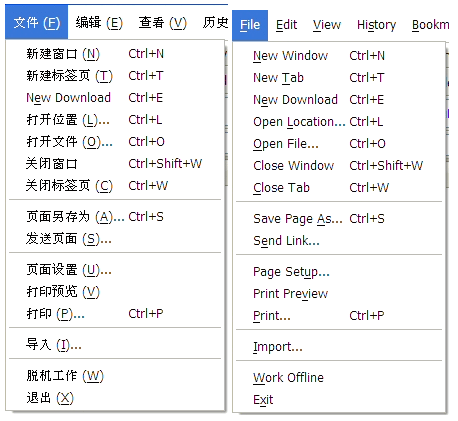
This is really useful for people like me who use both English and Chinese versions of the software regularly. Typically the situation is that I can use the software, but I can never remember what the various functions and features are called in Chinese. A post like this makes it a lot easier to actually learn them.
Well done, Bazza. (Originally posted on the ChinesePod Forum.)
18
Apr 2007Culturally Awkward
Today in my syntax class the teacher was trying to think of a sample sentence which involved a lot of verbs in a sequence. She started off with “I went to Beijing…” but was having trouble thinking of a sufficiently long sentence.
I piped up with, “I went to Beijing to meet a guy to buy a gun to kill a man.” Some people laughed.
The teacher responded, “No, that’s too violent.”
One of my classmates asked, “Are you making a reference to that news about the shooting in Virginia?”
“Huh?” I responded.
I didn’t know anything about it at the time, but I know about it now.
It’s weird… I’m not a violent person, and I’ve never had any interest in owning a gun, but I’m still American, and it came out in class in an unintentionally tasteless context. And just the other day I was explaining the Bill of Rights to a Chinese friend, and what the Second Amendment was, and how it’s really important in the USA.
I’m feeling really culturally awkward today.
16
Apr 2007Subtle Messages from Xintiandi
What is the message in this ad for Shanghai’s chic dining/shopping area, Xintiandi (新天地)?

I’m almost certainly reading too much into it, but this is what I see:
– To the Chinese women: “Hey, pretty, young, fashionable Shanghainese women! Come to Xintiandi, the place to be seen. Not only will men ogle you, but lots of handsome, single foreign men will ogle you! If you’re crazy enough not to want that, there are also Chinese men, most of whom are rich!”
– To the foreigners: “Hey, handsome male foreigners! We know you’re looking for Zhang Ziyi-esque women, and Xintiandi has them in droves. Don’t worry, the submissive local males will let you have them (as if you were worried!), and the women all want you, anyway.”
– To the Chinese men: “Hey, rich Chinese men! Come to Xintiandi, where you can flaunt your money with pretty young women and foreigners. Oh, but remember that it’s only polite to offer the ladies to the foreigners first.”
What has Xintiandi got against Chinese men? There may be tons of foreigners in Xintiandi, but I’m pretty sure the Chinese men are still the ones spending the big bucks. So for this reason the ad doesn’t make a lot of sense.
What have I got against Xintiandi? Nothing, really. I don’t particularly like it, but I don’t have any deep philosophical reasons for that. I’m mostly just cheap. In the past year I’ve started going there fairly often after work at ChinesePod for happy hour at Kabb. 20 RMB for Tiger draught is not bad.
14
Apr 2007ChinesePod V3 Launched
We’ve been working on the new version of ChinesePod for so damn long… and it has finally launched. We are all breathing a sigh of relief.
I have to say (as an “unbiased” commentator)… the new ChinesePod is a huge improvement in a lot of ways.
One of the coolest new features is that each user has his own account and custom profile, and they can interact much more easily.
We’re still squashing bugs and updating content, but after you get used to it, this new version is much, much better than its predecessor.
11
Apr 2007Character-based Sign Language
Shortly after I arrived in China and observed the deaf community in Hangzhou, a beautiful thought struck me. Deaf people communicate in an entirely different way. If all the deaf people in the world use sign language, they could all learn the same sign language and communicate with each other regardless of race or nationality. No barriers. A truly international language!
But alas, that was not to be. You see, sign language doesn’t just “substitute for” or “imitate” human language… it is a human language. As such, it is subject to the same restrictions and limitations by which all human languages are bound. In this case, one of the most important factors is that deaf communities are very often isolated. They’re isolated within a country, with a city, or within a district. Without a means to regularly communicate, communities drift apart linguistically over time.
Not only is Chinese sign language different from sign language of other countries, but it also varies from city to city. The sign language of Shanghai differs from that of Hangzhou or Beijing, for example. Even so, there is a national standard promoted. (I’m not sure how hard the Chinese deaf communities strive to adhere to it.)
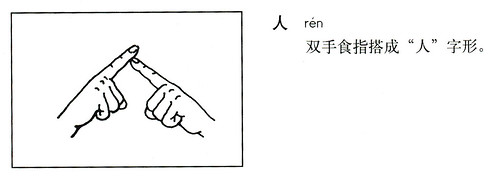
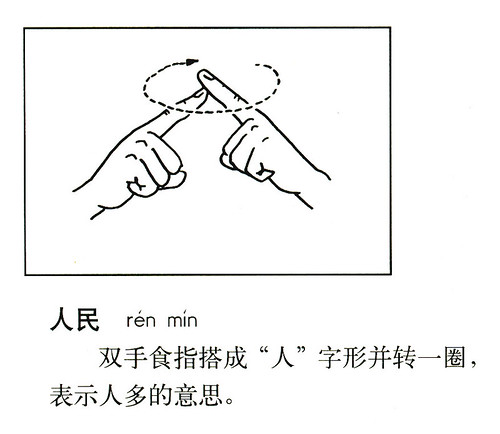
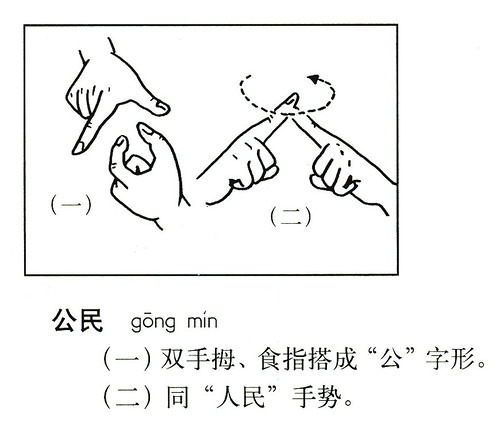
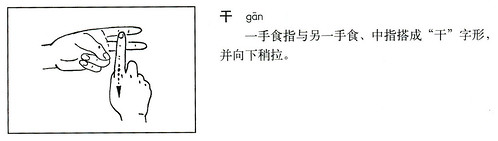
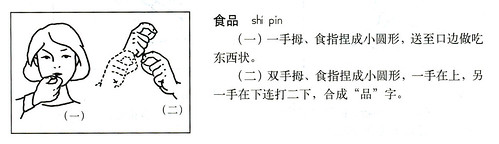
One of the ways that Chinese sign language sets itself apart is its references to Chinese characters. Certainly not all signs make reference to Chinese characters, and those signs that do make reference to characters don’t necessarily do it in a character-for-character way, but the influence of characters in Chinese sign language is tangible.
Here are a few examples from my book:
“person”
“people”
“citizen”
“dry”
“foodstuff”
I don’t actually know Chinese sign language… does anyone know any other interesting Chinese signs?
09
Apr 2007Pizza Hut Easter
So what does Easter mean in Shanghai? An outdoor Pizza Hut promotion in Xujiahui!
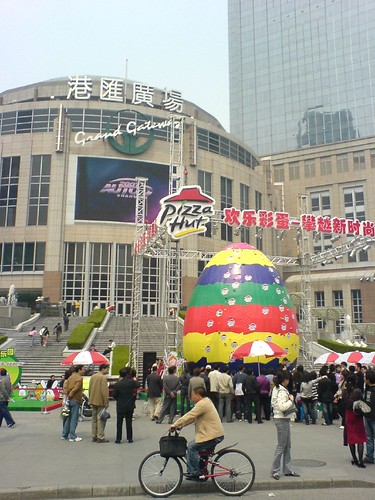

(That big egg is a kind of “rock-climbing” challenge, apparently.)


I didn’t stick around for the activity they were cooking up, but it looks like it is possibly inspired by the saga of Little Bunny Foo Foo?
08
Apr 2007Attempting Redemption
A while back I posted a story I titled “Betrayal.” I visited Yunnan and promised some friends that I would send them a photo when I returned to Hangzhou. But I never did. What’s more, I discarded the address so that I never could.
Well, it turns out I got some of those facts wrong. I moved to Shanghai in early 2004. I have moved twice since then. I am now in the apartment where I will begin my married life. Since I’ll be living with a Chinese woman, it’s necessary that I get rid of a lot of my old crap. I have some packrat genes, and it’s a part of myself that I detest. I never feel bad for having a lot of books, but it’s the other miscellaneous odds and ends that I need to do something about. A lot of it is old papers of questionable value, but I actually have to look at them before I can be sure they’re safe to throw out.
Anyway, I was going through that process recently when I found a familiar-looking old scrap of paper. It was the address of the restaurant in Jinghong, Yunnan! I never threw it out after all… I just packed it with everything else and lost it for over three years.
I have finally printed the photos and mailed them, as I promised I would. It’s been over 4 years, so I’m not sure those people are even still there, or if they’ll remember me at all. But whoever receives the letter will have a photo and a short note explaining it. I hope they see it.
07
Apr 2007Slag-hit Bank
Brendan has a very interesting post on good Chinese transliterations and bad Chinese transliterations. Check it out.
I wish he did posts like this more often (although I would probably settle for any posts more often…).